The Colonel Richard Gimbel Aeronautical History Collection

Printed Books  1851 – 1914


Narration By Will Ketterson

Introduction By Tom D. Crouch          

The task of selecting fifty titles from among the thousands of printed books in the Colonel Richard Gimbel Aeronautical History Collection is a daunting challenge. My goal has been to illustrate the depth and breadth of the Gimbel collection while describing some of the critically important books that both shaped and recorded the early history of flight.

The list includes significant works of science and engineering that played a key role in the development of flight technology, along with works of fiction that have inspired generations of flight enthusiasts. Solid histories of aeronautics share the list with items that explore the social and cultural impact of aviation. Otto Lilienthal's report of his pioneering glider experiments is included, as is the novel with an aviation theme that Sinclair Lewis wrote for boys. Whether science, fiction, or history, each of these books had an impact on history.

“In 1898 I read your War of the Worlds,” Robert Hutchings Goddard wrote to H. G. Wells in April 1932:

I was sixteen years old, and . . . the compelling realism of the thing made a deep impression. . . . I decided that what might conservatively be called “high altitude research” was the most fascinating problem in existence. . . . How many more years I shall be able to work on the problem, I do not know; I hope as long as I live. There can be no thought of finishing, for “aiming at the stars,” both literally and figuratively, is a problem to occupy generations, so that no matter how much progress one makes, there is always the thrill of just beginning.

Such is the power of the printed word to touch a life and through that life to shape a future. Housed in a library that serves the intellectual needs of America's future aerospace leaders are the precious volumes that provided a firm foundation for the age of flight. We owe Colonel Gimbel a great debt.


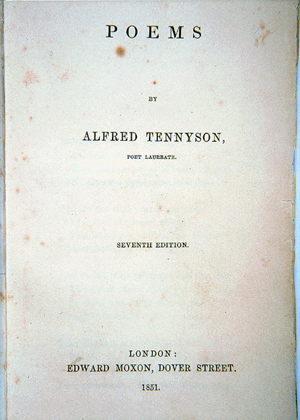
Tennyson, Alfred, Baron

Poems

7th ed. London: Edward Moxon, 1851. xii, 375 p. 17 cm.
PR5551.E51

Alfred Tennyson (1809-1892) earned high marks for prescience with the publication of "Locksley Hall." The poem is a long monologue in which a young man, disappointed in love and depressed by contemporary social problems, still expresses a solid Victorian faith in progress and the ability of human beings to shape their own destiny. Although the benefits of aerial commerce may be temporarily offset by the terrible vision of "airy navies grappling in the central blue," for example, the battle flags will eventually be "furl'd" and international disputes adjudicated "in the Parliament of man, the Federation of the world."

Tennyson returned to this theme in "Locksley Hall Sixty Years After" (1886). The narrator of the first poem, now an embittered old man, is comfortable with his own lot but no longer hopeful about the future.


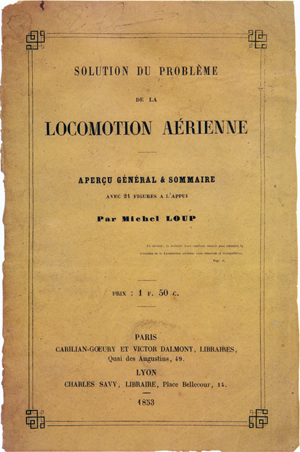
Loup, Michel

Solution du Problème de la Locomotion Aérienne: Aperçu Général & Sommaire, Avec 21 Figures à l'Appui, par Michel Loup

Paris: Carilian-Goeury et Victor Dalmont [etc.], 1853. 2 p. l., 75, [3] p. 2 fold. pl. 19.5 cm.
TLB399.L88
Brockett 7713
Bibliographic note: The copy held by the Gimbel collection is ex libris Gaston Tissandier.

Michel Loup produced the first well-considered French proposal for a powered airplane. The craft was a bird-like monoplane with fixed tandem wings, a tricycle undercarriage, and a large cruciform rudder and elevator. An engine powered twin propellers mounted between each triangular pair of wings.

Charles Harvard Gibbs-Smith, the eminent English authority on the prehistory of flight, remarks that Viscount Carlingford, in 1856, designed a tractor monoplane similar to Loup's machine, although it was to be powered by a single tractor propeller mounted on the nose. He apparently constructed a full-scale, unpowered version of this "aerial chariot," which was tested as a kite in Ireland.


[Goodrich, Samuel Griswold]

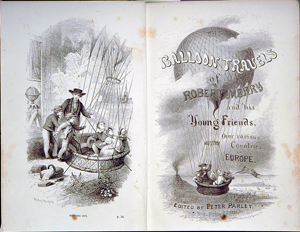
The Balloon Travels of Robert Merry and His Young Friends over Various Countries in Europe

Ed. by Peter Parley [pseud.] ... New York: J.C. Derby, 1856. viii, [9-312 p.] illus. 19 cm.
D980.G65  1856
[Randers-Pehrson 33]

Bibliographic note: The Gimbel collection holds fourteen Goodrich volumes.  Six of these are editions of the volume described.  Two of those editions, including the volume cited, are 1856 copies.  The others date to 1855, 1857, 1860, and 1866.


A native of Connecticut, Samuel Griswold Goodrich [1793-1860] devoted himself to providing reading material that would entertain, educate, and communicate moral lessons to young people.

Goodrich entered the publishing business in 1816 and issued the first of what would become a series of 116 Peter Parley titles (The Tales of Peter Parley About America) in 1827. Peter Parley was the pseudonym adopted by Goodrich and used for all the authors, including Nathaniel Hawthorne, whom he hired to produce books for the series.

Goodrich, who also served as a Whig member of the Massachusetts legislature and a U.S. Consul to Paris (1851-1853), was a publishing phenomenon who had sold as many as 7 million books by the time of his death in 1860. In addition, he published two successful children's magazines: Parley's Magazine (founded 1833) and Robert Merry's Museum (founded 1841).

The Balloon Travels of Robert Merry. . . is typical of the Parley volumes. Merry, the central character, leads a group of inquisitive youngsters on an adventurous balloon journey across Europe, during which he provides his young charges with information on history, geography, science, and other matters. Ballooning, the fictional editor explains in the preface, "provides an easy mode of traveling—that of gliding along in the air—and the opportunity it affords to move rapidly from country to country, looking down upon each and studying it like a map—surely must prove an effective mode of impressing their form and appearance upon the mind and memory."

"It is hoped too," Goodrich comments, "that the occasional passages of moral instruction given in the conversations of Robert Merry may be useful, by imparting sound morals and good manners. At all events, it is believed the work may contribute to the innocent pleasure of youthful readers, and for this object it is mainly intended."


Landells, E.

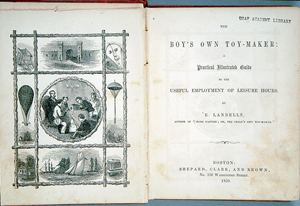
The Boy's Own Toy-Maker: A Practical Illustrated Guide to the Useful Employment of Leisure Hours. . .

Boston: Shepard, Clark, and Brown, 1859.  viii, 153 p. illus. 16 cm.
GV1201.L25


Books describing magic tricks and scientific experiments that could be performed or interesting toys that could be constructed using commonly available household items were great favorites with nineteenth-century youngsters. Some discussion of the scientific or technical principles involved in the individual projects was often included as a means of underscoring the educational value of the activity. No such book was worth its salt without a sampling of flight-related projects. Landells’ book, typical of the genre, provides step-by-step instructions for the construction of a fire balloon, two kinds of parachutes, and four varieties of kites.

Although the kites and parachutes were harmless enough, the paper fire balloons described by the author, kept aloft by bits of cotton soaked in turpentine, were genuine fire hazards. When Henry James senior, the future father of Henry and William James, was a 13-year-old student at the Albany Academy, he lost a leg after being badly burned attempting to extinguish a fire started by one of his own fire balloons.


Lowe, Thaddeus S[obieski] C[onstantine] 

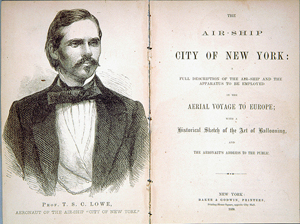
The Air-Ship City of New York: Full Description of the Air-Ship and the Apparatus to be Employed in the Aerial Voyage to Europe; with a Historical Sketch of the Art of Ballooning, and the Aeronaut's Address to the Public

New York: Baker and Godwin, Printers, 1859.  24 p. incl. front. (port.) pl. 19.5 cm.
TLD 921.C58L8
[Brockett 7736; Randers-Pehrson 36]

Bibliographic note:  In addition to this pamphlet, the Gimbel collection contains the following items by T.S.C. Lowe.  "Balloon Operations in the Civil War," in The War of the Rebellion: A Compilation of the Official Records of the Union and Confederate Armies, series III, v. iii, pp. 252-319.  Washington, D.C., 1899. 23 cm., Gamble 3672; T.S.C. Lowe, Early Aeronautic and Meteorological Investigations. Los Angeles: B.R. Baumgardt, 1895. 31 p. 23 cm.; T.S.C. Lowe, The Latest Development in Aerial Navigation.  [Los Angeles: Aerial Publishing Co., 1910?] 52 p. illus. facsim. 23 cm.


Six feet tall with broad shoulders, clear penetrating eyes, and a sweeping mustache, T.S.C. Lowe (1832-1913) emerged as a leading American aeronaut immediately prior to the Civil War. Born in Jefferson Mills, New Hampshire, he took an early interest in science and, from the age of twenty, earned his living as an itinerant lecturer. He made his first balloon ascent in 1856 and gained experience in a series of flights in the United States and began work on the balloon that was to be known as the City of New York in July 1859. The huge aerostat, designed to fly the Atlantic, had a diameter of 130 feet and stood 200 feet tall from the gas valve on top of the envelope to the keel of the lifeboat dangling beneath the basket. When filled with 725,000 cubic feet of coal gas or city illuminating gas, the balloon would lift an estimated 11.25 tons. Lowe began to inflate the balloon inside New York City's Crystal Palace Exhibition Hall in the fall of 1859. It soon became apparent, however, that the city gas works was not up to the task. Disappointed, Lowe shifted his operation to Philadelphia—and renamed the balloon Great Western. The envelope burst during a renewed attempt at inflation in October 1860. Undaunted, Lowe flew another balloon (named Enterprise) from Cincinnati to the Atlantic coast of South Carolina in April 1861. With the Civil war looming on the horizon, Lowe traveled to Washington, where he lobbied for a balloon reconnaissance effort.


Esterno, Henri Philippe Ferdinand, Comte d.'

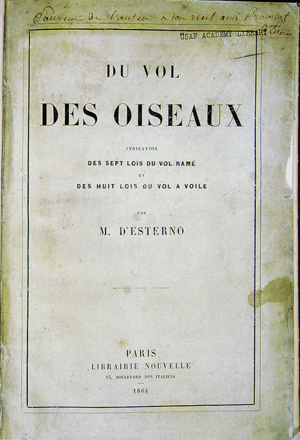
Du Vol des Oiseaux; Indication des Sept Lois du
Vol Ramé et des Huit Lois du Vol à Voile, par M. d'Esterno

Paris: Librairie Nouvelle, 1864. 61 p., 1l. illus. 2 pl. (1 fold.) 20.5 cm.
TLD181E7
Brockett 4192;  Gamble 5212

Count Henri Philippe Ferdinand Charles Honoré d'Esterno (1805-1883) was one of the most significant figures in mid-nineteenth-century aeronautics. Esterno was the first to underscore the notion of soaring, the ability of a bird to maintain or even gain altitude without beating its wings. Moreover, the Count called attention to alterations in the shape of a bird's wing as a means of controlling its attitude in the air. It should be noted, however, that Esterno did not fully understand the torsion of the wings as a means of effecting lateral control.

Moreover, in the interesting and advanced aircraft design presented in Du Vol des Oiseaux, the Count provided a moveable seat for the pilot, clearly suggesting that weight shifting would be a key element of the control system. There is little substance to the notion suggested after the invention of the airplane that Esterno was the first to describe the wing torsion control system pioneered by the Wright brothers. Esterno's general impact was, however, considerable.


Turnor, Christopher Hatton

Astra Castra; Experiments and Adventures in the Atmosphere. . .

London: Chapman and Hall, 1865.  xxiii, 530 p. front., illus., plates, ports. 31.5 cm.
TLB2511.T95
Brockett 12110; Gamble 373

Bibliographic note:  The Gimbel collection contains an additional uncatalogued copy of the same edition of this book.

Christopher Hatton Turnor (1840-1914), who listed himself on the title page of Astra Castra as an officer in the Prince Consort's Own Rifle Brigade, was a founding member of the Aeronautical Society of Great Britain (1866), later the Royal Aeronautical Society, and an original member of the governing council of that organization. He is best remembered, however, as the author of this volume, a chronological history of aeronautics from the earliest times to 1864.

Turnor provides a wide range of extracts and translations of flight-related documents, from the myths, legends, and poetry of classical times through the introduction and spread of ballooning, all knit together in a loose fashion with his own prose. The volume is, for its time, very well illustrated. The appendices range from speculative essays on meteorology and astronomy to a bibliography of books on flight and a list of the first 500 balloonists and the dates of their first ascents. For all of its eccentric quality, the book would remain for many years the most comprehensive and accurate treatment of the subject available in English.

The title is drawn from the motto of the Lindsay family: "Astra, Castra, Numen, Lumen." James Fairbairn, Fairbairn's Crests of the Leading Families of Great Britian and Ireland (Baltimore: Genealogical Publishing Co., 1963), confirms that a literal translation of the motto—"Star, Camp, God, Light"—is correct but offers no clue as to its meaning in the context of this volume.


Andrews, Solomon

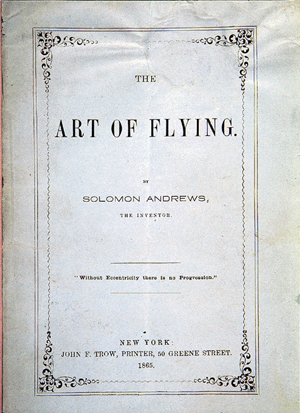
Aerial Navigation and a Proposal to Form an Aerial Navigation Company, by Solomon Andrews, M.D., The Inventor

(Cover title: The Art of Flying) New York: John F. Trow, 1865. 32 p. 25 cm.
TLD902.A56
Gamble 3535; Randers-Pehrson 41

Bibliographic note:  The Gimbel collection contains a second facsimile copy of this work, bound with a facsimile of Solomon Andrews, The Aereon, or flying ship, invented by Solomon Andrews.  New York: John F. Trow & Co. Publishers, for the Aerial Navigation Company, 1866. 16 p. 32 cm.  An illustration of "The First Aereon of 1863" is included, apparently as the back cover sheet of the original.

Solomon Andrews, a classic inventor-mechanic, and one-time mayor of Perth Amboy, New Jersey, was one of the most persistent of all mid-nineteenth-century American experimenters with dirigible airships. His earliest plans for the navigation of the air dated to the 1840s, but it was not until he returned from a tour of duty as a surgeon with the Union army that he began construction of the first "aereon."

The craft consisted of three 80-foot-long cigar-shaped balloons constructed by aeronaut John Wise. Andrews planned to employ a sort of aeronautical perpetual motion to propel the craft. The force of the air on the top or bottom of the gasbags, which could be angled nose up or down from an operator's car suspended 16 feet beneath the balloons, would cause the vehicle to climb or descend. The momentum built up in a descent could be used to power a climb.

A series of apparently successful flights beginning in 1862 led to initial efforts to interest government officials in the project. When funds were not forthcoming, Andrews established a joint stock venture, which funded work on a second craft in 1866. Additional flights with the new machine were impressive but did not result in the increased funding required to sustain the effort; Andrews was forced to abandon the work.


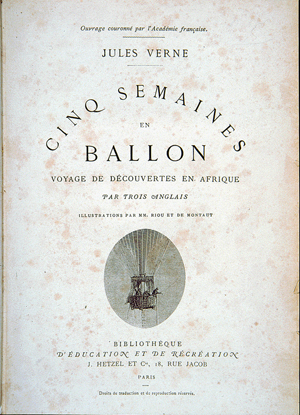
Verne, Jules

Cinq Semaines en Ballon, Voyage de Découvertes en Afrique par Trois Anglais;  Illustrations par MM. Riou et De Montaut

Paris: J. Hetzel, [186?]. 2 p. l., 267 p. incl. front., illus., double map. 28.5 cm.
PQ2469.C5
Bibliographic note:  The Gimbel collection also holds a second Hetzel edition of this novel dated 1885.  In addition, there are eight American editions:  two copies of  Five Weeks in a Balloon; or, Journeys and Discoveries in Africa, by Three Englishmen. Compiled in French by J. Verne, from the original notes of Dr. Ferguson [pseud.] and done into English by W. Lackland.  New York: D. Appleton & Co., 1869. 1 p. l., 345 p. plates. 12 cm., Randers-Pehrson 47; same title, New York: R. Worthington, 1882. [2], 345 p. illus. 19 cm.; same title, New York: Pollard & Moss, 1887. [2], 345 p. illus. 19 cm.; same title, New York: Mershon Co. [n.d.]. 265 p. 19 cm. "Arundel edition"; . . . Five Weeks in a Balloon; an Abridged Translation. . . by Charles J. Finger.  Girard, Kansas: Haldeman-Julius, [ca. 1923]. 64 p. 12.5 cm. (Little Blue Book No. 482) Text ends on p. 57. “Pocket Series no.482.”


Jules Verne (1828-1905) was, with Herbert George Wells, the most influential contributor to the literary genre that would be known as science fiction. Born at Nantes, France, the young Jules Verne earned his living as a stock broker but loved literature and the theater. He produced a string of unpublished stories and unproduced plays prior to 1862, when he began his association with J. Hetzel, a successful author and publisher of children's literature. Anxious to obtain new material for a children's magazine, Hetzel encouraged Verne to try his hand at producing a novella with an adventurous theme. The result was Cinq semaines en ballon... a tale in which three companions cross Africa in a balloon. The plot is less complex and dramatic than later and more famous novels like Twenty Thousand Leagues Under the Sea, Journey to the Center of the Earth, or From the Earth to the Moon. Still, it fits the pattern of the classic Verne Voyages extraordinaires—an adventurous tale with strong didactic elements in which a group of individuals make exciting use of technology to undertake a dangerous and exciting journey. It was the book that launched an extraordinary literary career.


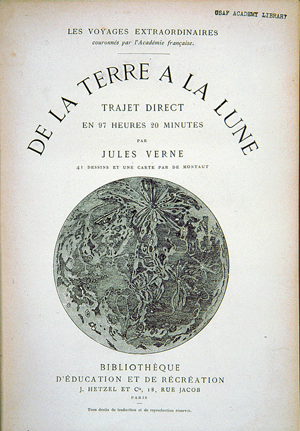
Verne, Jules

De la Terre à la Lune;  Trajet Direct en 97 Heures 20 Minutes, par Jules Verne;  41 Dessins et une Carte par le Montaut

Paris: J. Hetzel et Cie [1866]. 2 p. l, 170 p. illus. 27.5 cm.
PQ2469.D3 1866

Bibliographic note:  The Gimbel collection holds two copies of the edition cited.  In addition, the collection features: same title, Nouvelle éd. Paris: Collection Hetzel, [1867].  [1]-305 p. illus. 19.5 cm.  The collection holds only two English-language translations of the book:  Miller, Walter James, The Annotated Jules Verne: From the Earth to the Moon, Direct in Ninety-Seven Hours and Twenty Minutes. . . New York:  Crowell, 1978.  [168]-171 p. and From the Earth to the Moon. London: Lock and Tyler, [1876?].  (Bound with a translation of the sequel, Round the Moon and a copy of A Journey into the Interior of the Earth. 3 vol. in 1. illus. 18 cm.)  The Gimbel collection includes only one French edition of the sequel: ... Autour de la Lune, par Jules Verne ... Paris: J. Hetzel, [1867?].  180 p. illus. 28 cm.  The collection boasts a considerable number of  English-language editions in which the two volumes are presented as a single book.  From the Earth to the Moon, Direct in 97 Hours 20 Minutes; and a Trip Round It ... Tr. from the French by Louis Mercier ... and Eleanor King ... London: Sampson Low, Marston, Low, and Searle, 1873.  viii, 323 p. illus. 20.5 cm.; another copy by the same press dated 1874; 111; same title, New York: Scribner, Armstrong and Co., 1874.  viii, 323 p. illus. 20 cm.; a second edition from the same publisher, vi, 323 p. illus. 19 cm.; same title, London: Ward, Locke and Tyler, [1876?]. 3 vol. in 1. illus. 18 cm.; same title, New York: Lowell, [1876?]. 3 vol. in 1. illus. 18 cm..; same title, New York: Lowell, [1888?]. 125, 151 p. 19 cm.  (Hawthorn series);  same title, New York: C. Scribner's Sons, 1893, viii, 323 p. illus. 21 cm.; From the Earth to the Moon and Round the Moon, by Jules Verne... New York: A.L. Burt Company, [190?]. 1 p.l., 330 p. 19 cm.  (Publisher's lettering: The Home Library); Miller, Walter James, The Annotated Jules Verne; From the Earth to the Moon, Direct in Ninety-Seven Hours and Twenty Minutes, New York: Crowell, 1978. [168]-171 p.


De la Terre à la Lune... is one of the best and most influential of Jules Verne's Voyages imaginaires. The second of the author's adventure tales, it recounts the journey of artillery expert Impey Barbicane and two companions From the Earth to the Moon. The three make the trip in a hollow artillery shell weighing 30,000 pounds, fired from "The Columbiad," a 68,000-ton, 9,000-foot-long cannon buried up to the muzzle in the soil of Florida. At the end of the book, and a 97-hour, 20-minute trip through space, the three voyagers are left orbiting the moon. Anxious readers had to wait for the rescue in the sequel, Autour de la Lune (1870). Unlike most Verne tales, the real purpose of the two novels is to outline some of the problems barring the way to spaceflight and to describe the technology that might make such a trip possible, or at least thinkable. 

Konstantine Tsiolkovskii and Hermann Oberth, who, along with the American Robert Goddard, offered the first mathematical proofs of the possibility of spaceflight and outlined some of the key technological steps that would lead to eventual success, dated their own early fascination with the subject to a reading of From the Earth to the Moon.


Aëronautical Society of Great Britain
[Royal Aeronautical Society]

Report 1-8, [1866-1873]; 9-15 [1874-1880]; 16-23 [1881-1893].
London and New York: Cassell, Petter, and Galpin, [1866]; Greenwich: Henry S. Richardson, [1867-1893]. 23 vol. in 3. illus., plates, diagrs. 18 cm.
TLB14.R88
[Brockett 197; Gamble 4578]


The Aeronautical Society of Great Britain was not the first organization of its kind in the world, but it was certainly the most significant and influential. Founded in 1866, the Society attracted both talented amateur experimenters and distinguished professional engineers interested in the subject. The leaders of the group arranged informative lectures and technical meetings, and sponsored the first public exhibition of aeronautical technology. The published series of annual reports proved to be the organization's most important contribution, however.

The best of the papers published in the early reports were marked by a determination to extend the power of contemporary engineering theory and practice into aeronautics. Francis Herbert Wenham's description of the wind tunnel experiments that he and John Browning conducted at Penn's Engineering Works, Greenwich, for example, opened a new era in the history of flight research. (See "Concluding Remarks," Sixth Annual Report of the Aëronautical Society of Great Britain for the Year 1871, pp. 73-81.) Today, the wide-ranging technical materials published by the Royal Aeronautical Society continue a tradition established in 1866.


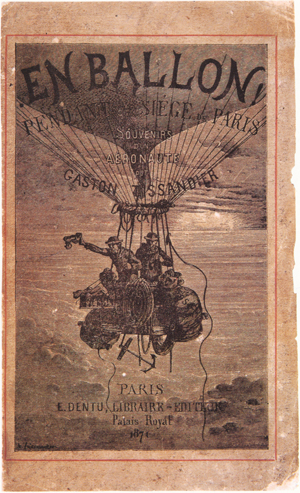
Tissandier, Gaston 

En Balloon! Pendant le Siège de Paris.  Souveniers d'un Aéronaute par Gaston Tissandier, Professeur de Chimie, L'Association Polytechnique, Directeur du Laboratoire de l'Union Nationale, etc.

Paris:  E. Dentu, 1871. 3 p.l., xv, 318 p. 18.5 cm.
DC313.T61
Brockett 11883

Bibliographic note:  Ex libris Horace Oswald Short, with decorated book-plate.  The Gimbel collection contains a much better known account by the same author, Gaston Tissandier, Souvenirs et Récits d'un Aérostier Militaire de l'Armée de la Loire, 1870-1871.  Paris: Maurice Dreyfous, 1891. x, 356 p., incl. front. illus., plates, facsim. 28.5 cm.  Brockett 11874; Gamble 3771.  The collection also contains a copy of another standard account:  G. de Clerval, Les Ballons Pendant le Siège de Paris;  Récits de 60 Voyages Aèriens, Reunis et mis en ordre par G. de Clerval ... Paris: F. Wattelier, 1871. 148 p. 20 cm., Brockett 2821.  Colonel Gimbel collected a wide range of additional items relating to the Franco-Prussian War, including manuscripts, medals, newspapers, and prints.

The French army marched off to battle in July 1870, confident of its ability to defeat Prussia. Within weeks, however, the cream of the army was besieged at Metz, while Emperor Napoleon III was defeated at Sedan. By early September, panic and the spirit of revolution were sweeping through the streets of Paris. A new Government of National Defense began taking shape as two Prussian armies moved toward the capital. The Siege of Paris was under way. During the long months of isolation, which ended with the armistice and surrender in January and February 1871, the sight of balloons bobbing above the skyline or flying to safety carrying mail and official news to the outside world provided a source of hope and pride for thousands of Parisians. During the course of the siege, more than 65 balloons carried 164 passengers and 11 tons of paper, ranging from government dispatches to an estimated 2.5 million letters to the outside world. All but 8 of the balloons succeeded in carrying their cargo to friendly hands. Carrier pigeons were also pressed into service by this first official airmail operation.

In addition to their involvement with the Paris post, French aeronauts served with military units continuing to operate in the field. Gaston Tissandier recounts his experience as one of the aeronautical heroes of the Franco-Prussian War. In addition, he provides an early account of the famous aerial post in which balloons and pigeons carried mail out of Paris and Metz.


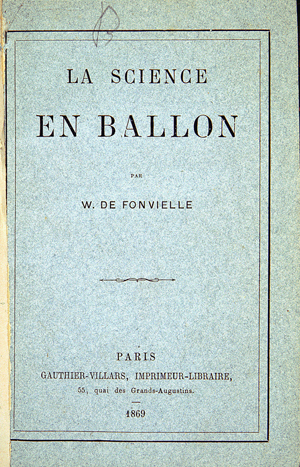
Fonvielle, Wilfrid de

La Science en Ballon. . .

Paris:  Gauthier-Villars, 1869. 3 p. l., xvi, 141 p. 11. 18 cm.
TLB273.F68s
Bibliographic note:  This copy is marked: "A.F. Zahm, Notre Dame, Ind." Zahm was a controversial aviation pioneer who taught physics for a time at Notre Dame.  In addition to the single edition of the volume noted, the Gimbel collection includes the following volumes by Fonvielle:  Les Ballons-sondes et les Ascensions internationales, précédé d'une Introduction par J. Bouquet de la Grye ... 2nd ed. Paris:  Gauthier-Villars, 1899. ix, 148 p. 11. illus. (incl. maps), diagrs. 19 cm. (Gimbel copy is ex libris Albert Tissandier); Notre Flotte aérienne, par Wilfrid de Fonvielle et Georges Besançon ... Paris: Gauthier-Villars, 1908. 2 p.l., 234 p. illus. (incl. ports.) 22 cm., Brockett 4863A; Falempin, ou l'espion aérien: Roman patriotique du Siège de Paris ... Paris: E. Gaillard, [1910?]. 270 p. illus. 29 cm.  The collection also contains several copies of James Glaisher, Voyages aériens to which Fonvielle contributed.

Wilfrid de Fonvielle (1826-1914), a scientist who had been exiled to Algeria for a time as a result of his liberal political views, was the author of works on a variety of popular scientific topics, including human fossils, insects, and meteorology. He was best known, however, as a scientific balloonist, a historian of ballooning, and one of the aeronaut-heroes of the Siege of Paris.

He first came to public attention as a balloonist in 1867, when he accompanied Jules Godard on a flight above the clouds to observe a meteor shower. It was the first in a long series of scientific flights described in La Science en Ballon. One of the great aeronauts of the era, well known as both a scientific and sport balloonist, Fonvielle was elected the first president of the Aéro-Club de France in 1893.


Wise, John

Through the Air: a Narrative of Forty Years' Experience as an Aeronaut.  Comprising a History of the Various Attempts in the Art of Flying by Artificial Means from the Earliest Period Down to the Present Time.  With an Account of the Author's Thrilling Adventures and Hairbreadth Escapes.

Also an Appendix, in which are Given Full Instructions for the Manufacture and Management of Balloons.  By John Wise.

Philadelphia, New York, Boston and Chicago: Today Printing and Publishing Co., 1873. 630 p. incl. col. front., plates, ports, facsim. 24 cm.
TLB273.W81
Brockett 12948; Gamble 850; Randers-Pehrson 57

Bibliographic note:  Through the Air is a revised and enlarged edition of an earlier Wise volume: TLB251.W81.  A System of Aeronautics, Comprising its Earliest Investigations, and Modern Practice and Art.  Designed as a History for the Modern Reader, Account of Various Attempts in the Art of Flying by Artificial Means, from the Earliest Period Down to the Discovery of the Aeronautic Machine by the Brothers Montgolfier, in 1782, and to a Later Period, with a Brief History of the Author's Fifteen Years' Experience in Aerial Voyages.  Also, full instructions in the art of making balloons... Philadelphia: J.A. Speel, 1850. xvi, [17]-310 p. front. (port.), plates, 22 cm., Brockett 12945; Gamble 849; Randers-Pehrson 28.  The Gimbel collection contains only one copy of Through the Air and two copies of System of Aeronautics (cited here) and a second edition:  Fairfield, Wash.:  Ye Galleon Press, 1979. 310 p. illus. 28 cm. In addition, the collection contains a copy of John Wise, Lightning and the Lightning Rod; Use and Abuse of the Rod, Thunder and Thunderstorms, Thirty Years in the Clouds.  Lancaster, Pa.: Pearsol, 1870. 39 p. 23 cm.


Born in Lancaster, Pennsylvania, John Wise (1809-1879)  became nineteenth-century America's best known aerial voyager. Trained as a cabinet and piano maker, he made over 450 balloon ascents between his first flight in 1835 and his death while attempting to fly across Lake Michigan. A leading balloon builder, Wise pioneered the use of new materials for the construction of envelopes, new sealing varnishes, and technological innovations like the ripping panel, which enabled an aeronaut to empty the envelope immediately after landing.

Wise carried the first air mail officially sanctioned by the U.S. Post Office, popularized the notion of aerial photography, and argued forcefully for the use of aerial reconnaissance as early as the Mexican War. Unlike most other aeronauts of the period, Wise was genuinely interested in science, particularly meteorology, which he defined as "the geology of the atmosphere." He built his reputation on his extraordinary skill as an airman, however.

Wise was involved in some of the great long-distance flights undertaken in antebellum America, notably an 809-mile flight from St. Louis, Missouri, to Henderson, New York, in June 1859. He was perhaps best known for his unrealized dream of flying the Atlantic. Through the Air remains one of the classic American aeronautical autobiographies.


Verne, Jules

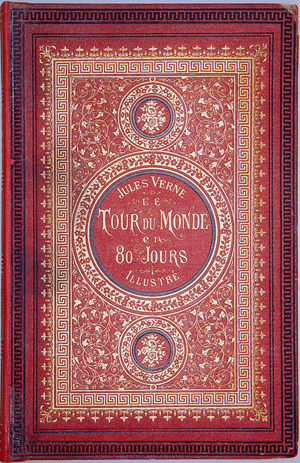
Le tour du monde en quatre-vingts jours, par Jules Verne. . .

Paris: J. Hetzel, [1874]. 2 p. l., 217, [3] p. incl. front., illus., maps. 27.5 cm.
PQ2469.T7  1874

Bibliographic note:  In addition to the single French volume cited, the Gimbel collection contains two English-language editions:  The Tour of the World in Eighty Days, by Jules Verne ... Translated by George M. Towls.  Boston:  J.R. Osgood, 1874. 291 p. front. 15 cm. (The Santerer's Series); same title, Chicago and New York: Belford Clarke, 1884. 320 p. illus. 19 cm.

Compared to Jules Verne's more complex novels, Around the World in Eighty Days is a relatively straightforward adventure tale with a simple point. By the last quarter of the nineteenth century, the advent of the steamship and transcontinental railroad travel had drastically reduced the time required to travel to the far corners of the world. Verne's hero, a London clubman, wagers that he can girdle the globe in eighty days. Restricted to modes of locomotion that were actually available, the free balloon was Verne's only opportunity to launch his circumnavigating heroes into the skies.

Throughout his career, Verne based one story after another on lighter-than-air flight technology. As far as we know, however, the author made only one flight, a short ascent from Amiens in 1873 with aeronaut Eugène Godard.


Amick, M.L.

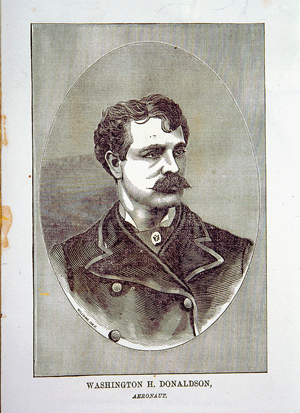
History of Donaldson's Balloon Ascensions, Laughable Incidents, Frightful Accidents, Narrow Escapes, Thrilling Adventures, Bursted Balloons...  Comp. and Arranged by M.L. Amick,  M.D.  Illustrated from the original drawings of Donaldson.

Cincinnati News Company, 1875. 199, [1] p. front. (port.), plates. 22.5 cm.
TLB276.D66A6
Brockett 564; Gamble 535; Randers-Pehrson 61

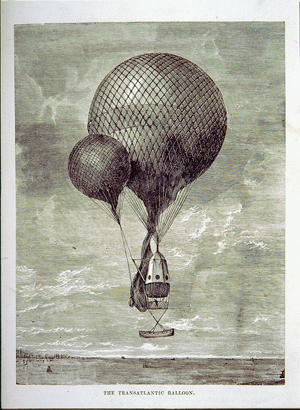
Washington Harrison Donaldson (1840-1875), born in  Philadelphia in 1840, earned early fame as a gymnast, acrobat, tightrope walker, and aerialist. At the time of his first ascent in 1871, he employed the balloon as little more than a flying acrobatic platform. Donaldson performed his feats of aerial derring-do on the load ring of the balloon or dangling from a trapeze bar that substituted for the basket.

As Donaldson gained experience in the air, he came to share the desire of an older generation of American balloonists to fly the Atlantic. He reached the height of his fame in 1873, as a result of the publicity surrounding an abortive attempt to conquer the ocean with an enormous balloon, the Daily Graphic, funded by the newspaper of the same name. Like John Wise, Donaldson died as a result of an unsuccessful attempt to fly across Lake Michigan.

M.L. Amick, a Cincinnati physician and an acquaintance of Donaldson, provided a classic portrait of the career of a leading aerial showman, complete with delightfully primitive woodcut illustrations.


Sircos, A. [Alfred] and Pallier, Th.

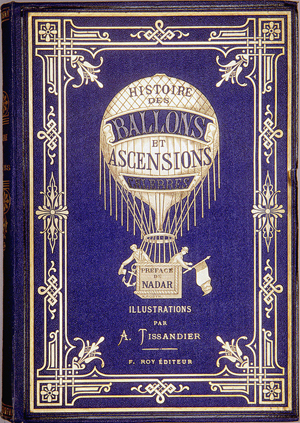
Histoire des Ballons et des ascensions célèbres; [avec une] préface de Nadar: Dessins de A. Tissandier et des meilleurs artistes

Paris: F. Roy, 1876. 2 p. l., 476 p. front., illus. (incl. ports.) 29 cm.
TLB273.S61
Brockett 11263;  Gamble 803

With an introduction by Gaspard-Félix Tournachon (Nadar), the great French photographer-aeronaut, and illustrations by aeronaut Albert Tissandier (1839-1906) and other artists, Histoire des Ballons... is one of the best of several classic histories of ballooning that appeared in the late nineteenth century. The text is generally accurate but offers a much stronger coverage of the early history of  ballooning than of the prehistory of flight. The illustrations are worthy of special note.


Tissandier, Gaston

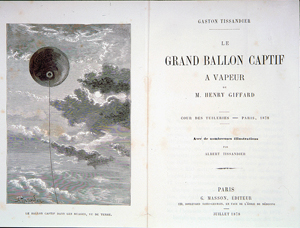
Le Grand Ballon Captif à Vapeur de M. Henri Giffard.  Cour des Tuileries—Paris, 1878.  Avec de Nombreuses Illustrations, par M. Albert Tissandier

Paris:  G. Masson, 1878. 67, [1] p. incl. front., illus., plates (part double) 22.5 cm.
TLB276.G4T61
Brockett 11942; Gamble 820

Bibliographic note:  This volume is ex libris Gaston Tissandier.  The Gimbel collection also contains a second copy of this edition; and a Nouvelle édition, also 1878 and ex libris Gaston Tissandier.  In addition to those volumes by Gaston Tissandier specifically cited here and elsewhere in this book, the Gimbel collection contains the following items: ...Application de l'Électricité  à la Navigation Aérienne; l'Aérostat Électrique à Hélice de MM. Albert et Gaston Tissandier ... Notre Présentée à  la Société d'Encouragement le 11 janvier 1884... Paris, Imprimerie J. Tremblay, 1884.  16 p. illus., fold. pl. 26.5 x 22.5 cm.; Les Ballons dirigeables.  Application de l'électricité à la navigation aérienne, par Gaston Tissandier... Ouvrage accompagné de 35 figures et de 4 planches hors texte.  Paris:  Gauthier-Villars, 1885. 2 p.l., [vii]- xii, 108 p. incl. front. illus., plates, map. iv double pl. 19.5 cm., Brockett 11871; Gamble 1350; Les Ballons dirigeables; Expériences de M. Dupuy de Lôme en 1872, par Gaston Tissandier... Paris:  E. Dentu, 1872. vii, 62 p. illus. 18 cm.; Deux Conférences sur les aérostats et la navigation aérienne, par Gaston Tissandier; 1st La Métérologie en ballon; Conférence faite au Congrès scientifique de Lille, le 21 août 1874. 2nd la Direction des Aérostats; Conférence faite à la Sorbonne, le 3 mai 1883.  Suivies du catalogue des projections relatives aux aérostats.  Paris:  A. Molteni, [1884]. 87, [1] p. incl. front. 19 cm.; Histoire de mes ascensions; Récit de Quarante-cinq Voyages aériens (1868-1888) par Gaston Tissandier... Paris:  M. Dreyfous, [pref. 1888]. 2 p.l., ii, [ix]-xxiv, 308 p. incl. front., illus., plates, diagrs. 26.5 cm.; La Navigation aérienne; l'Aviation et la direction des aérostats dans les temps anciens et modernes, par Gaston Tissandier... Ouvrage illustré de 99 Vignettes. Paris: Hachette et Cie, 1886. 2 p. l., ii, 334 p., il. incl. illus., plates, front. 18.5 cm.; Les Martyrs de la Science.  Ouvrage Illustré de Trente-quatre Gravures sur Bois, Compositions de Camille Gilbert.  Paris:  M. Dreyfous, [1879]. 334 p. illus. 25 cm.; Le Présent et l'avenir de l'aéronautique, par Gaston Tissandier ... le 19 septembre 1889. 39 p. 20 cm.; La Photographie en ballon, par Gaston Tissandier... Paris:  Gauthier-Villars, 1886. vii, 45 p., il. incl. illus., plates, front. (mounted phot.) 21 cm.; Science, Patrie; Conférence faite par... le 29 novembre 1889, au siège de l'Association des Dames françaises... Amiens:  Delattre-leNoel, 1889. 15 p. 21 cm; Simples Notions sur les ballons et la navigation aérienne par Gaston Tissandier, avec un Frontispice par Albert Tissandier et 36 vignettes par G. Mathieu.  Paris:  Librairie illustrée, [1876]. viii, [9]-125 p., il. incl. front., illus. 16.5 cm. (ex libris Gaston Tissandier).


The huge captive balloon that operated as a central attraction at the Paris World's Fair of 1878 was perhaps the largest aerostat ever constructed. With a capacity of 883,000 cubic feet of hydrogen, the balloon was capable of lifting 17 tons. Fifty passengers at a time would be admitted into the circular car. Allowed to rise high above the Paris skyline, the balloon was pulled back down to earth by a powerful steam winch. An estimated 35,000 individuals took advantage of the opportunity to obtain a spectacular view of the City of Lights during the course of the exhibition. Henri Giffard, the brilliant engineer who designed and supervised the construction of the huge craft, had also built and flown the world's first genuinely successful powered airship. A 144-foot-long, spindle-shaped craft powered by a 3 h.p. steam engine, Giffard's dirigible balloon flew for the first time in 1852. Giffard built his first very large tethered balloon, a 176,500-cubic-foot aerostat, for the Paris Exposition of 1867. Two years later, he provided a similar balloon for a London exhibition. Wilfrid de Fonvielle and Gaston Tissandier, the author of this account, made a series of flights with the London aerostat, now the world's largest free balloon, in an effort to raise money for an aerial expedition to the North Pole.


Flammarion, Camille

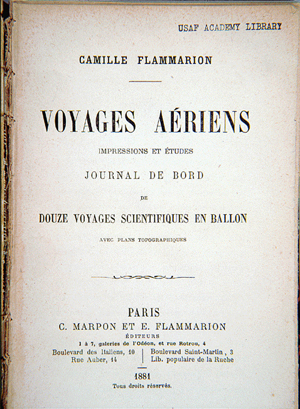
Voyages aériens; Impressions et études; Journal de bord de douze voyages scientifiques en ballon; avec plans topographiques

Paris: C. Marpon et E. Flammarion, 1881. 2 p. l., 384 p. illus. (maps) 19 cm.
TLB273.F58
Brockett 4604
Bibliographic note:  This copy is inscribed: "A Mademoiselle Marie Levy-Bing—sympathique hommage—C. Flammarion, Mois des Fleurs, 1881."  The Gimbel collection contains a second copy of this edition, ex libris Albert Tissandier.

An astronomer with the Paris Observatory, Camille Flammarion (1842-1925) made a dozen scientific ascents with aeronaut Eugène Godard, 1867-1870. In this report of those flights, the author focuses on meteorology, reporting on the temperature, humidity, clouds, and air currents encountered aloft. Flammarion also conducted aerial experiments involving optics, acoustics, and astronomy.


Mouillard, Louis Pierre

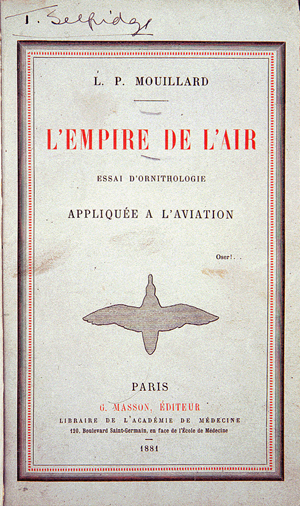
L'Empire de l'Air: Essai d'Ornithologie appliquée à l'aviation

Paris: G. Masson, 1881.  284 p. illus. 26.5 cm.
TLD181.M92
Brockett 8837; Gamble 5270

Louis Mouillard (1834-1897), a native of Lyons, abandoned a promising career in art to emigrate to Algeria; he farmed there until 1865 when he fled to Cairo as a result of political problems. His interest in flight was initially aroused by observing the birds. Some of his most important publications, including L'Empire de l'Air, focused on bird flight rather than on his own aeronautical experiments or glider designs.

Mouillard built three gliders in the 1850s, in one of which he succeeded in making at least one significant flight. He corresponded with the leading aeronautical enthusiast Octave Chanute in the 1890s. Chanute funded a glider constructed by Mouillard in Cairo during the mid-1890s, and arranged for an English translation of L'Empire de l'Air and its re-publication by the Smithsonian Institution. Chanute was convinced that his friend's description of aerodynamic control in bird flight represented the earliest technical explanation of the lateral control technique developed by the Wright brothers.


Tissandier, Gaston

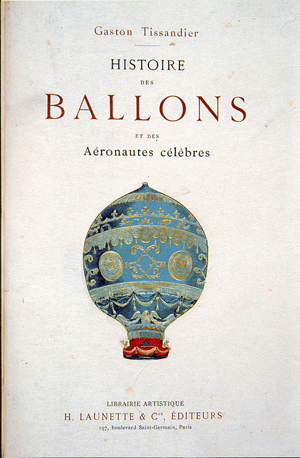
Histoire des Ballons et des Aéronautes célèbres,
Volume 1, 1783-1800; Volume 2, 1801-1890

Bibliographic note: "Il a été fait une édition spéciale de grand luxe à vingt-cinq exemplaires numérotés sur papier du Japon, avec une double suite des toutes les planches en photogravure."  No 25.

Gaston Tissandier (1843-1899), a research chemist and one of the leading sport and scientific balloonists of nineteenth-century France, made some 40 ascents during an active career that stretched from 1868 to 1886. His most famous flight was an ascent from Paris on April 17, 1875, aboard the balloon Zénith. Accompanied by scientists Theodore Sivel and Joseph Croce-Spinelli, and equipped with an experimental oxygen apparatus, Tissandier was determined to break an altitude record established by Henry Coxwell. Tissandier lost consciousness at 22,800 feet. He recovered to find his companions dead on the bottom of the basket and the balloon dropping very rapidly toward the earth.  He was the only survivor. Gaston Tissandier, who had written his name large in the annals of flight, was fascinated by the development of aeronautics and produced a classic history of ballooning.


Coxwell, Henry

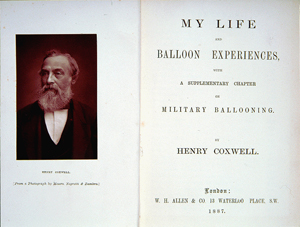
My Life and Balloon Experiences, with a Supplementary Chapter on Military Ballooning

London:  W.H. Allen and Co., 1887, 1889. 2 v. front. (v. 1) 13 plates.  19 cm.
TLB290.C87
Brockett 3157; Gamble 514


Henry Tracey Coxwell (1819-1900), one of the most colorful and experienced of all British aeronauts, made his first flight in 1844, his 500th in 1863, and his 1,000th (and last) in 1885. Throughout his long career, he developed a reputation for both courage and hairbreadth escapes. On July 6, 1847, Coxwell ascended from Birmingham with several passengers and 60 pounds of fireworks.  Caught in a thunderstorm, the balloon burst at 4,000 feet. Coxwell allowed the lower portion of the envelope to invert into the upper netting, forming a parachute that returned the party safely to earth.

Coxwell made one of the most famous ascents of all time on September 5, 1862, when he set out from Wolverhampton with scientist James Glaisher to study atmospheric and physiological conditions at high altitudes. Passing through  30,000 feet, the expanding balloon pulled the valve line out of reach. With Glaisher unconscious, Coxwell, his hands frozen, climbed up onto the load ring and pulled the valve line with his teeth. Both men survived.

In addition to his well-publicized  scientific ascents, Coxwell experimented with aerial reconnaissance, bomb dropping, and other aspects of military aeronautics.  In 1870 and 1871 he conducted a series of important flights at Cologne and Strasbourg and helped to organize and train a balloon unit for the German army.


Tissandier, Gaston

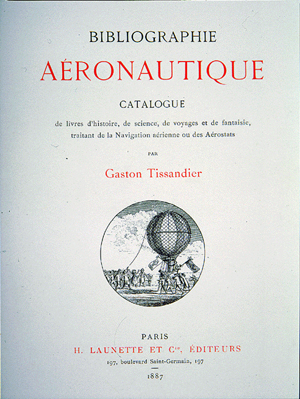
Bibliographie aéronautique:  Catalogue de livres d'histoire, de science, de voyages et de fantaisie, traitant de la Navigation aérienne ou de Aérostats. . .

Paris:  H. Launette, 1887. 2 p. [5]-62 [2] p. 29 cm.
Z5063.T61
Brockett 11919; Gamble 32

Bibliographic note: "Il a été fait une édition spéciale de grand luxe à vingt-cinq exemplaires numérotés sur papier du Japon." This copy was annotated by Colonel Richard Gimbel.

In addition to being a leading aeronaut, designer of aerostats, and historian of aeronautics, Gaston Tissandier was also an important collector of books and manuscripts on aeronautics and artifacts relating to the history of flight. His Bibliographie lists over 800 items covering all aspects of the subject. With illustrations reproduced on high-quality Japanese paper, the book remains a classic guide to early aeronautica.


Lilienthal, Otto

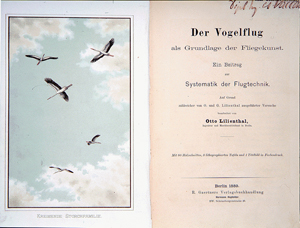
Der Vogelflug als Grundlage der Fliegekunst:  Ein Beitrag zur Systematik der Flugtechnik.  Auf Grund zahlreicher von O. und G. Lilienthal ausgeführter Versuche bearbeitet von Otto Lilienthal ... Mit 80 Holzschnitten, 8 lithographierten Tafeln und 1 Titelbild in Farbendruck

Berlin: R. Gaertners, 1889. viii, 187 p. col. front., illus. VIII fold. diagr. 23.5 cm.
TLD181.L72v
Brockett 7557; Gamble 5239


Germany's Otto Lilienthal (1848-1896) the author of this work whose title translates to "Birdflight as the basis of aviation:  a contribution toward a system of flight technology," began his serious work in aeronautics with engineering tests conducted during the years 1866-1870, 1873-1874, and 1885-1889. His basic goal was to measure the lift and drag produced by different airfoil shapes at various angles of attack. Working with his brother Gustav, Lilienthal began by demonstrating that cambered, or curved, wings produce greater lift than a flat plate and then proceeded to identify what he believed to be the most efficient airfoil shapes.

Having published his results in Der Vogelflug, Lilienthal turned from theory to practice. Between 1890 and 1896, he completed some 2,000 glides in 18 distinct glider designs. Photographs and eyewitness descriptions of his flights convinced the readers of magazines and newspapers that the age of winged flight was at hand.

Otto Lilienthal died on August 10, 1896, as a result of injuries suffered in a glider crash. He inspired the generation of experimenters who would take the final steps toward the invention of the airplane. The technical information in Der Vogelflug provided subsequent experimenters with a starting point; they, in turn, corrected Lilienthal's data and improved on his research.


Langley, S[amuel] P[ierpont]

Experiments in Aerodynamics

Washington, D.C.:  Smithsonian Institution, 1891.  iii, 115 p. incl. tables, diagrs.  x plates (part fold.) 33.5 cm.  (Smithsonian Contributions to Knowledge) [v. 27, n. 1]  Smithsonian Institution publication 801.
TLD209.L28
Brockett 7166; Randers-Pehrson 82

Bibliographic note:  This volume is an account of Langley's earliest experiments.  The design, construction, and testing of several models and full-scale aerodromes are covered in: Langley Memoir on Mechanical Flight, Parts 1 and 2.  Washington, D.C.:  Smithsonian Institution, 1911. 1 v. illus., plates (part double) diagrs. 33.5 cm.  (Smithsonian Contributions to Knowledge, v. 27, n. 3), Smithsonian Institution publication 1948.

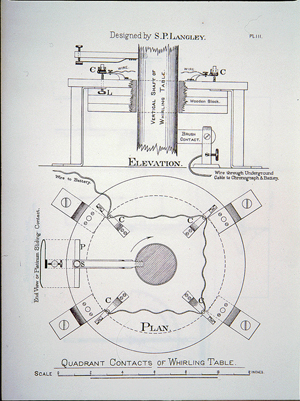
The third secretary, or director, of the Smithsonian Institution, Samuel Langley (1834-1906) earned fame as a pioneer astrophysicist and an administrator of science. Interested in flight since childhood, he began a series of aerodynamic experiments in 1886-1887, while he was still director of the Allegheny Observatory at the Western University of Pennsylvania (now the University of Pittsburgh). His goal was to answer the basic question:  Is it possible to design and build a successful mechanical, heavier- than-air flying machine? "The most important general inference from these experiments," Langley reported in Experiments in Aerodynamics,  "is that... mechanical flight is possible with engines we now possess." Having demonstrated to his own satisfaction that the basic problem could be solved, Langley would spend the last decade of his life attempting to develop a practical flying machine. He began by testing small flying models powered by strands of twisted rubber, then moved on to steam-powered "aerodromes" with wingspans up to 15 feet. In 1896, after five years of effort, Langley's team achieved sustained flight with two of these models. The final step, which came between 1898 and 1903, involved the design and construction of a full-scale aerodrome. The craft was destroyed during a final unsuccessful attempt at a test flight in December 1903.


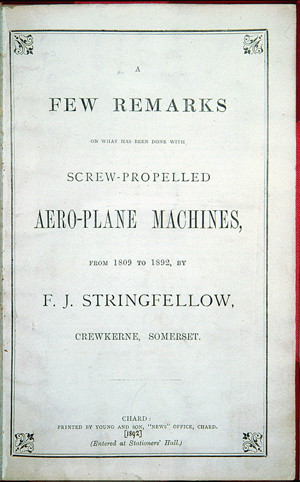
Stringfellow, F[rederick] J[ohn]

A Few Remarks on What Has Been Done with Screw-Propelled Aero-Plane Machines, from 1809 to 1892

Chard, England:  Young and Son, 1892. 14 p. 6 mounted illus. 21.5 cm.
TLB252.S91.A2
Brockett 11592

Frederick John Stringfellow (1832-1905) was a native of Chard, England.  His father, John Stringfellow (1799-1883), was an aeronaut, amateur scientist, and brilliant engineer who had developed light steam engines for industrial applications. In 1840, Stringfellow and William Samuel Henson (1805-1888) began a collaborative effort to solve the problems of powered, heavier-than-air flight. Two years later, Henson patented the design for a high-wing, passenger-carrying monoplane with a 150-foot span. Over the next decade, the Aerial Steamship as it became known, inspired a series of both serious and comic graphic prints that spread the fame of Henson and Stringfellow throughout Europe and America.

The collaboration ended in 1848, when Henson emigrated to the United States.  In later years, Frederick Stringfellow claimed a short, sustained free flight for a steam-powered model with a 10-foot wingspan developed by his father during this period. Stringfellow and son were awarded a £100 prize for a lightweight steam engine designed to power a triplane model displayed at the Aeronautical Society of Great Britain exhibition in 1868. Frederick, who developed a series of multiplane models following his father's death, sought to ensure that the contributions of W.S. Henson and two generations of Stringfellows would not be forgotten.


Brewer, Griffith, and Alexander, Patrick Y.

Aëronautics: An Abridgment of Aëronautical Specifications Filed at the Patent Office from A.D. 1815 to A.D. 1891.

London: Taylor and Francis, 1893. vi, 160, [16] p. illus. 21.5 cm.
TLD38.B84
Brockett 505; Gamble 166

In May 1891, Patrick Y. Alexander (1867-1943), a wealthy English balloonist and technological enthusiast, accompanied Griffith Brewer (1867-1948), a patent agent and amateur aeronaut, on a flight from Chelsea. Striking up a friendship, the two men decided to collaborate on a digest of existing British aeronautical patents. Her Majesty's Patent Office had already issued an annual index of all patents, but Brewer and Alexander did not believe that it was particularly useful to flying machine experimenters. "Many of the specifications," they noted in the preface, "describe inventions which are impractical... ridiculously absurd... and probably the result of dreams."

The two collaborators were determined to produce an annotated compendium of existing patents that would help serious investigators separate the wheat from the chaff. Brewer conducted most of the basic patent research, while Alexander evaluated the designs and identified key features. The resulting volume is still of interest and value to historians of flight technology.

Griffith Brewer (who eventually became a close friend, student, business associate, and supporter of the Wright brothers) was one of the great figures in the early history of British aviation. Although considerably less influential than Brewer, Patrick Alexander would remain a well-known figure in aeronautics during the years prior to World War I.


Chanute, Octave

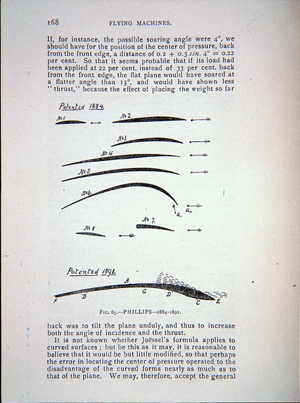
Progress in Flying Machines by O. Chanute, C.E.

New York: American Engineer and Railroad Journal, [1894].
iv, 1l., 308 p. illus. 22.5 cn.
TLB251.C45 1894
Gamble 1485; Randers-Pehrson 99

A native of Paris, France, Octave Chanute (1832-1910) immigrated to the United States with his father in 1838. At the age of 17 he took a position as an apprentice with a railroad construction crew and rose through the professional ranks to become one of the leaders of American civil engineering during the years following the Civil War.

In the early 1870s, Chanute became fascinated by the aeronautical experiments undertaken by French and English engineers. He immersed himself in the literature of the field and began to correspond with virtually every major experimenter of flying machines in the world. In 1886, Mathias Forney, editor of the American Engineer and Railroad Journal, invited Chanute to publish a series of articles on aeronautics. Twenty-seven installments of the series "Progress in Flying Machines" were published in the journal beginning in October 1891. Forney published the entire series, revised and expanded by the author, as a book of the same title in 1894. This volume, combined with Chanute's lectures, his support of promising young experimenters, and his involvement in the design and testing of hang gliders, established the engineer and author as one of the world's leading authorities on flight.

The most important association of Chanute's life began in May 1900, when he received a letter from Wilbur and Orville Wright, the owners of a small bicycle shop and manufacturing facility in Dayton, Ohio. Over the next decade, Chanute served as an important sounding board for the Wright brothers, introduced them to the larger international circle of aeronautical experimenters, and generally publicized their work. In spite of a general cooling in their relationship with Chanute after 1905, the Wrights never doubted the value of his friendship and support. "By the death of Mr. O. Chanute the world has lost one whose labors had to an unusual degree influenced the course of human progress," Wilbur Wright noted in January 1911. "No one was too humble to receive a share of his time. In patience and goodness of heart he has rarely been surpassed. Few men were more universally respected and loved."


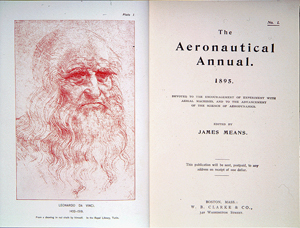
Means, James, ed.

The Aeronautical Annual. . . Devoted to the Encouragement of Experiment with Aerial Machines, and to the Advancement of the Science of Aerodynamics.  Edited by James Means.  no. 1-3; 1895-1897

Boston:  W.B. Clarke & Co., 1894-1897. 3 v. illus.
TLB237.A25
Brockett 8288, 8289, 8290; Randers-Pehrson 102, 105, 112

Bibliographic note:  The Gimbel collection also contains a copy of The Epitome of the Aeronautical Annual... Ed. by James Means... Boston: W.B. Clarke Company, 1910. 4 p.l., 5-220 p. front., illus., plates, ports. 23.5 cm.  The epitome includes reprints from the original three volumes together with some new material.  Additional Means items in the collection include:  James Means, Manflight, by James Means.  Boston: James Means, 1891. 29 p. diagrs. 23.5 cm., Brockett 8285; Randers-Pehrson 83; James Means, The Problem of Manflight, by James Means.  Boston:  W.B. Clarke & Co., 1894. 20 p. incl. diagrs. 23 cm., Brockett 8292; Gamble 2443;  Randers-Pehrson 97; James Means, Five Patents Relating to Aviation.  Boston, [1909?].  [7] p. 22 cm.; James Means, The James Means Control for Flying Machines.  Boston, 1913.  [12] p. illus. 18 cm.; James Means, Twentieth Century Energy:  A Pamphlet which Treats Briefly of an Unseen Yet Potent Form of Matter, by James Means.  Boston: W.B. Clarke & Co., 1896.  19 p. 23 cm.


James Howard Means (1853-1920), a native of Massachusetts who had made a fortune in the shoe business, became a center for aeronautical enthusiasm in the Boston area and a major publicist in the cause of heavier-than-air flight. Convinced that rivalries and miscommunications between experimenters were retarding the search for a successful airplane, Means was determined to establish a publication that would offer useful and trustworthy information to the entire aeronautical community.

The first volume of the Aeronautical Annual focused on figures from the relatively distant past:  Leonardo da Vinci, Sir George Cayley, F.W. Wenham, Thomas Walker, and Benjamin Franklin. In the second and third volumes, however, Means featured articles by the leading experimenters of the day:  Otto Lilienthal, Octave Chanute, S.P. Langley, Hiram Maxim, and others. Although the publication was relatively short-lived, it did become a forum for the presentation of the latest research, as Means had hoped.


Lachambre, Henri, and Machuron, Alexis

Andrée and His Balloon

Westminster:  A. Constable, 1898. 305 p. illus. 20 cm.
G700.L13 1898

Bibliographic note:  In addition to this volume on the construction of the balloon Ornen and the early history of the Andrée expedition, the Gimbel collection also contains books published after the discovery of the remains on White Island.  The most important of these is Svenska sällskapet för antropologi och geografi (Swedish Society for Anthropology and Geography), Andrée's Story: The Complete Record of His Polar Flight, 1897, from the Diaries and Journals of S.A. Andrée, Nils Strindberg, and K. Fraenkel, found on White Island in the Summer of 1930.  Translated from the Swedish by Edward Adams-Ray.  New York: Viking Press, 1930.  Gamble 4507

Henri Lachambre and his associate and nephew, Alexis Machuron, were among the leading balloon builders of fin de siècle Paris. During the winter of 1895-1896, the firm won the contract for the construction of a very large balloon designed to carry a crew of three from the Norwegian island of Spitsbergen to the North Pole and on to a safe landing. Salomon August Andrée, chief engineer of the Swedish Patent Office, was to head the expedition, accompanied by Nils Strindberg and Knut Fraenkel. The project was privately funded and attracted the support of both Alfred Nobel and King Oscar of Sweden.

The finished balloon, named the Ornen (Eagle), had a volume of 170,000 cubic feet. It was constructed of 3,360 individual pieces of silk sewn together with 8.4 miles of thread. Fifteen miles of Italian hemp made up the net that supported the large closed basket, or gondola. The expedition was well equipped to deal with any emergency encountered aloft or on the ice.  The intrepid explorers would report their progress to a waiting world via carrier pigeon.

At 1:43 P.M. on the afternoon of July 11, 1897, the Ornen rose slowly to an altitude of some 300 feet over Dane Island, Spitsbergen, then began to move in a northeasterly direction over Virgo Harbor. The first serious attempt to reach the North Pole by air was under way at last. The balloon dipped so low that the basket touched the water, then rose rapidly to an altitude of 1,950 feet. Observers on shore noted that the huge craft was still moving to the northeast when it vanished into the clouds and into history, at 1:56 P.M.

The disappearance of the Ornen and its three passengers, Salomon August Andrée, Nils Strindberg, and Knut Fraenkel, was one of the first great mysteries of the air age. Thirty-three years later, on August 5, 1930, the Bratvaag, a sealing vessel chartered by a Norwegian scientific expedition, sent a party ashore to explore White Island, a remote spot of land east of Spitsbergen. To their astonishment, members of the party stumbled into the last camp of the Andrée expedition.  In addition to the remains of the three explorers, the crew of the sealer found cameras, diaries, logbooks, letters, maps, and diagrams that chronicled the expedition from takeoff until October 7, 1897. Developed more than three decades after they had been taken, the photographs provided a ghostly visual record of the final days of the Andrée expedition. The old mystery was solved.

The records revealed that the Ornen had crashed on the ice far to the northeast of Spitsbergen just three days after takeoff.  Their dream of reaching the pole dashed, the three explorers had then started back toward the Arctic coast on foot, dragging what equipment and supplies they could salvage. Their goal was to reach Spitsbergen before winter.

Instead, they were forced to pitch their final camp on White Island. All three men died within a few days of reaching the island. Death came as a result of exposure to the elements, although other factors, notably the consumption of tainted polar bear meat, have also been cited as possible causes of death.



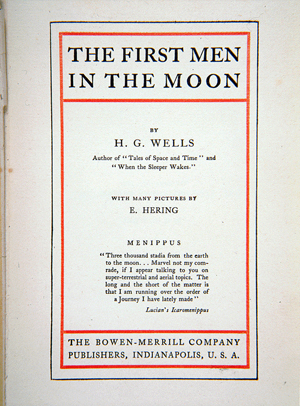
Wells, H.G. [Herbert George]

The First Men in the Moon... With Many Pictures by E. Hering

Indianapolis:  Bowen-Merrill Company, [1901].  4 p. 312 p. front, plates, 20 cm.
PR5774.F5  1901a

H.G. Wells (1866-1946) was, with Jules Verne, the most important and influential early contributor to the literary genre that would become known as science fiction. Although the best of his early novels (The Time Machine [1895], The Island of Dr. Moreau [1896], The Invisible Man [1897], The War of the Worlds [1898]) are more concerned with the impact of science on society than with technical detail, he clearly had a gift for inspiring dreams.

By 1915, Robert H. Goddard, the American spaceflight pioneer, was already deeply involved in his early rocket experiments. His diary records that he read H.G. Wells' The First Men in the Moon on July 19, 1898. Ten days later, after a morning spent working on rocket nozzles and pumps, he looked the book over a second time. Then, on August 8, Goddard had a vivid dream in which he flew to the moon.

"In 1898 I read your War of the Worlds," Goddard informed Wells in 1932. "I was sixteen years old... and I decided that what might conservatively be called 'high altitude research' was the most fascinating problem in existence." Like Verne, Wells delighted millions of general readers and inspired a handful of geniuses to transform the dream into reality.


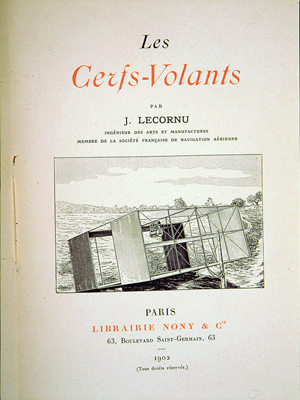
Lecornu, Joseph

Les Cerfs-Volants . . .

Paris: Librairie Nony et Cie, 1902. 2 p.l., [iii]- 240 p. illus., diagra. 22.5 cm.
TLD951.L46
Brockett 7362; Gamble 2652

Experience with kites, the oldest flying objects constructed by human beings, played a critically important role in the invention of the airplane. Joseph Lecornu, a graduate engineer and member of the French Aerial Navigation Society, produced the best introduction to the theory, practice, and history of kites that was available to the engineers who designed and built the first airplanes.

The book opens with a useful introduction to the theory of kite design and proceeds to a discussion of materials, construction techniques, and similar practical matters. Over half of the volume is devoted to aspects of kite history and to a discussion of specialized topics, including man-lifting kites, kite photography, meteorological kites, and the use of kites for scientific research. A careful and detailed treatment of the subject, Les Cerfs-Volants remains as useful and interesting an account as it was at the time of publication almost a century ago.


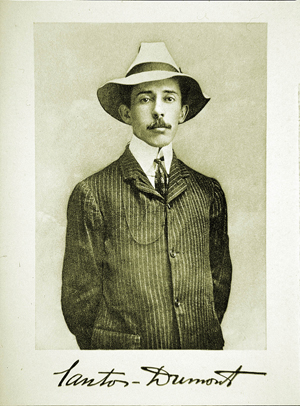
Santos-Dumont, Alberto

My Air-Ships, by A. Santos-Dumont

New York:  The Century Co., 1904. ix, 356 p. incl. plates, ports., diagrs., front. 19.5 cm.
TLB290.S23
Brockett 10808

Bibliographic note:  The Gimbel collection has a second copy of this volume:  My Air-Ships, New York:  Dover, 1973, xviii, 122 p. 22 cm.  In addition, the collection has other volumes by Santos-Dumont:  Alberto Santos-Dumont, Dans l' Air, Paris:  Charpentier et Fasquelle, 1904. 2p.l., 343 p. 21.incl. illus., plates, port., front. 21 cm.; Alberto Santos-Dumont, O que eu vi. São Paulo:  Typ. Piratininga, 1918. 100 p. illus. 22 cm.; Albert Santos-Dumont, Os meus balões, [Rio de Janeiro]:  Biblioteca do Exército, 1973. 260 p. illus. 23 cm. (Coleção General Benício, vol. 109.)

Alberto Santos-Dumont (1873-1932) was one of the most colorful figures in the early history of powered flight. Le Petit Santos weighed only about 110 pounds and stood 5 feet 5 inches tall in his shiny patent leather shoes fitted with lifts.  Dark hair, parted sharply in the center and plastered in place with pomade, capped a cadaverous face. Those who knew him assure us that his faintly comic appearance masked a cold patrician manner. His enthusiasm for flight was so all-encompassing that he ate at a table and chair suspended 6 feet above the floor of his dining room.

The son of a wealthy Brazilian coffee planter, Santos-Dumont came to Paris in 1897 to acquire an engineering education. He acquired a balloon instead, but quickly tired of operating at the mercy of the winds. Prior to the turn of the century he ordered the first in what would become a series of 15 small, one-man airships. One of the great moments of his career came on October 19, 1901, when he won the 100,000-franc Deutsch de la Meurthe Prize for a flight from the Aéro-Club de France hangar at Saint-Cloud to the Eiffel Tower and back in less than half an hour.

The sight of the little Brazilian chugging along just above the rooftops of Paris epitomized the spirit of the Belle Époque, but Santos-Dumont soon grew as dissatisfied with pressure airships as he had with the free balloon. Inspired by news of what the Wright brothers were accomplishing in the United States, and armed with an imperfect understanding of Wright technology, Santos-Dumont began work on an airplane. On the afternoon of October 23, 1906, that aircraft, 14-bis, flew for roughly 164 feet at an altitude of 9 to 16 feet. For the first time, an airplane had made a publicly announced flight.

A second aircraft developed by Santos-Dumont, La Demoiselle, established him as one of the preeminent designers of the era. Diagnosed as suffering the early stages of a debilitating disease, however, he retired from active involvement in aeronautics prior to World War I. Depressed by his own failing health, by a series of air disasters that had taken a heavy toll on human life, and by an outbreak of violence in Brazil in which air power was a factor, Alberto Santos-Dumont took his own life on July 23, 1932, three days after his fifty-ninth birthday.


Root, A.I.  [Amos Ives]

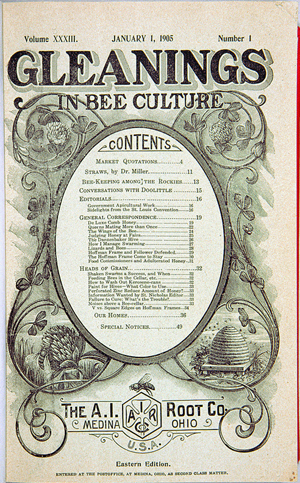
"Our Homes, By A.I. Root," in Gleanings in Bee Culture

v.33, no. 1, January 1, 1905, pp. 36-38.
SF521.G4 33

By September 20, 1904, Wilbur and Orville Wright had been flying from Torrence Huffman's cow pasture, some 8 miles east of Dayton, Ohio, for some time. They had made their first powered flight at Kitty Hawk, North Carolina, on December 17, 1903, and returned home to Dayton determined to find a local site where they could continue to practice flying and perfect their machine in relative seclusion. After a less than impressive demonstration flight in the spring of 1904 that discouraged curious local reporters, the pair settled on Huffman Prairie.

The world was still not aware of the fact that the Wright brothers had invented the airplane, but Amos Root was determined to correct the situation. A resident of Medina, Ohio, Root operated a very successful beekeeping supply house and edited Gleanings in Bee Culture, a trade journal. For some weeks he had been hearing vague rumors about two minister's boys who were emulating the birds in a field near Dayton. Fascinated by all things mechanical, he drove south in his automobile to investigate for himself:

Imagine a locomotive that has left its track, and is climbing up in the air right toward you. . . . Well, now, imagine this white locomotive, with wings that spread twenty feet each way, coming right toward you with a tremendous flap of its propellers, and you will have something like what I saw. The younger brother bade me move to one side for fear it might come down suddenly; but I tell you friends, the sensation that one feels in such a crisis is hard to describe.

For the first time in history, an airplane had turned in full circles, and Amos Root had been there to see it. Gleanings in Bee Culture had scooped the great newspapers of the world on the story of the century.


Zeppelin, Ferdinand Adolf August Heinrich, Graf von

Erfahrungen beim Bau von Luftschiffen.  Vortrag gehalten auf der 49.  Hauptversammlung des Vereines deutscher Ingenieure zu Dresden am 29. Juni 1908

Berlin:  Verlag von Julius Springer, 1908. 23 [1] p. 22 cm.
TLD901.Z5e
Brockett 13167; Gamble 1417

Count von Zeppelin (1838-1917), the single most important figure in the history of the rigid airship, served as an officer in the German army between 1861 and 1891. The first flights of La France in 1884, along with the publication of several key papers, fired Zeppelin's imagination and convinced him that Germany should develop an airship of its own. When a prestigious state commission rejected his initial impractical design, Zeppelin turned to Professor Muller-Breslau, who assisted in the development of the classic cigar-shaped craft.

After Zeppelin organized a joint stock company in 1894, work began on the design and construction of the LZ1, which made its first flight over Lake Constance on July 2, 1900. In spite of their impressive size, the early zeppelins were woefully underpowered and difficult to control. Not until the LZ3 (1906) did the Count begin to taste genuine success. During the period between 1906 and 1913 zeppelin enthusiasm was rampant, as the huge airships seen cruising over the cities of the Reich became the very symbol of German strength and technological achievement.


Girard, E., and Gervais, A. de Rouvelle

Les Ballons dirigeables:  Théorie—Applications; avec 143 figures dans le texte

Paris:  Berger-Levrault & Cie, 1907. 2 p.l., 307p. illus., diagrs. 22.5 cm.
TLD901.G51
Gamble 1069

From the last half of the nineteenth century until 1906-1908, with the full emergence of the German rigid airships, France dominated the field of large navigable airships. Henri Giffard (1852) and Gaston and Albert Tissandier (1883) built and flew the earliest steam and electrically powered dirigibles, neither of which was able to exceed 10 miles per hour in still air. It remained for Paul Renard and Arthur Krebs, of the French military balloon facility at Chalais-Meudon, to produce the first marginally practical airship, La France, in 1884.  Even after the initial success of the early zeppelins, Chalais-Meudon and other French manufacturers continued to produce large airships, including Lebaudy (Le Jaune, 1902), Astra (Ville de Paris, 1906/1907; La Patrie, 1907), and Clement-Bayard (Clement-Bayard, 1908).

Unlike the zeppelins, rigid airships in which gasbags were located inside a rigid, fabric-covered framework, all of the French craft were semirigids, or pressure airships, in which a single large gasbag was attached to an external keel. Les Ballons dirigeables, a review of the leading French airships, is a reprint of articles originally published in the Revue du Génie militaire from July 1906 to January 1907.


Ostoya, Victor, E.

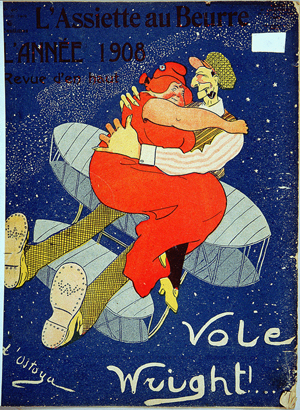
Vole, Wright!

Paris, 1908.  642-656  p. illus. 31 cm. (L'Assiette au Beurre, no. 405, Janvier 1909)
TLB290.W95

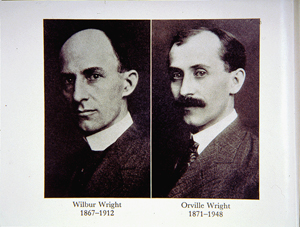
There was simply no precedent for the incredible wave of incredulity, excitement, and enthusiasm that gripped first France, then all of Europe, following the first public demonstration flight of a Wright aircraft at a Le Mans racetrack on August 7, 1908. Periodically over the next century, one aerospace figure after another would emerge as the next great hero of the hour—Louis Blériot, Charles Lindbergh, Amelia Earhart, Jean Mermoz, Italo Balbo, Yuri Gagarin, the Apollo astronauts. None of them would match the extent to which Wilbur and Orville Wright would stun the world.

Between 1903 and 1908, there was little proof that the Wrights had flown. The brothers had purposely not made any public flights, and they had not released many photographs of their aircraft in the air. When the Americans refused to try for the rich prizes being offered to would-be aviators, most French aviation experimenters assumed that the Wrights were "bluffeurs." The first flights at Le Mans swept all of those doubts away and instantly established Wilbur Wright as the most famous man in Europe.

Caricatures of "Veelbur Reet," with a bird-like beak and a soft, peaked cap, were everywhere, as this typical collection of comic sketches and text demonstrates.


Peyrey, François

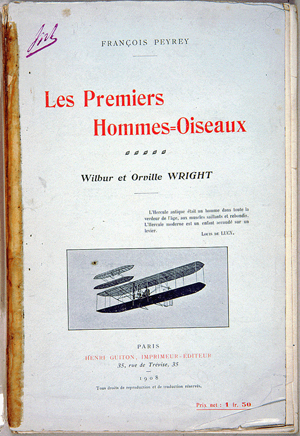
Les Premiers Hommes-Oiseaux, Wilbur et Orville Wright

Paris:  H. Guiton, 1908. 2.p.l., [9]-78 p. 1l. illus. (incl. plan) plates, ports., map, 24 cm.
TLB290.W95P

Bibliographic note:  The Gimbel collection holds a good selection of Peyrey's books on the birth of aviation.  In addition to the first edition cited, the collection contains. . . Les Premiers Hommes-Oiseaux; Wilbur et Orville Wright. . . Édition Nouvelle, Relatant Toutes les Expériences des Frères Wright en France et aux  États-Unis ' Amérique. . . Paris:  H. Guiton, 1909. 3 p.l., [9]—151 p. 21 illus. (incl. maps, plans) plates, ports. 24.5 cm. (cover signed by the author); . . . Au Fils du vent; avec une préface du comte Henri de la Vaux. . . Paris:  H. Guiton, 1909. 2 p.l., [9]—303 p. illus., plates, ports. 28.5 cm.; L'oeuvre de l'Aéro-Club de France et l' Aéronautique contemporaine. Paris:  H. Dunod et E. Pinat, [1910]. 2 p.l., 149 p. illus. (incl. ports.) 22.5 cm.;. . . Les Oiseaux artificiels; avec une préface de Santos-Dumont. Paris:  H. Dunod et Pinat, 1909. 3 p.l., [v]-xiv, 667 p. illus., diagrs. 23 cm.

There can be no doubt that François Peyrey (1873-1934) was le premier historien des frères Wright en France. He provided French readers with the first full and trustworthy accounts of the brothers, from their roots in Dayton, through their experiments in America (1900-1905), to their first spectactular public flights in 1908. At the time, Peyrey's books were fuller and more accurate than any accounts of the Wrights available in English.


Ferber, Ferdinand

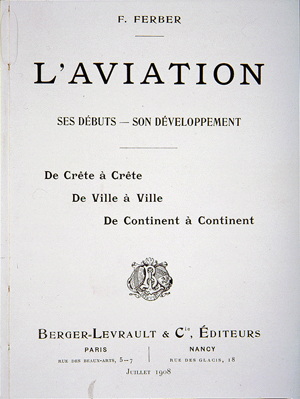
L'Aviation; ses Débuts—son Développement; de Crête à Crête, de Ville à Ville, de Continent à Continent

Paris, Nancy:  Berger-Levrault & Cie, 1908. xii, 250 p. illus., diagrs. 23 cm.  ("Les Calculs," p. [107] - 248 is a revision of the author’s:  Les Progrès de l'aviation par le vol plané; les calculs. 1907.)
TLB251.F34  1909

Bibliographic note:  The Gimbel collection contains a second copy of this edition (Cinquième tirage) and a 1910 Nouvelle édition.  Other holdings by Captain Ferber include: Les Progrès de l'aviation par le vol plané; les calculs, par F. Ferber... avec 26 figures dans le texte.  Paris, Nancy:  Berger-Levrault & Cie, 1907. 85 [1] p. illus. diagrs. 23 cm.; Les Progrès de l'aviation depuis 1891 par le vol plané; les calculs, par F. Ferber... avec 44 figures dans le texte.  Paris, Nancy: Berger-Levrault & Cie, 1905. 53 p. il. illus. 22 cm.  "Deuxième édition.";  "Extrait de la Revue d'artillerie-mars 1904." ...Die Kunst zu Fliegen... Berlin:  R.C. Schmidt & Co.; New York:  Steiger & Co., 1910.  215 p. illus. (incl. ports.) diagrs. 22.5 cm.

Ferdinand Ferber (1862-1909) was primarily responsible for the rebirth of French interest in aviation after 1900. A native of Lyons and a professional artillery officer, Ferber was something less than the ideal soldier. He was overweight, walked with a slouch, and was apparently a less than dashing horseman. Although chronically nearsighted, he refused to wear spectacles. Legend has it that he once failed to spy the approach of a general officer, missed giving a salute, and was thus doomed to remain a captain.

Ferber became interested in flight in 1898, while serving as an instructor at the École d'application. He corresponded with aviation pioneers, including both Clément Ader and Otto Lilienthal's brother, Gustave, and, by 1900 had built and flown a variety of craft, from a kite to a rather crude copy of a standard Lilienthal glider. A letter to Octave Chanute in 1901 led to his discovery of the work of the Wright brothers.

Ferber built and flew a very crude biplane glider, inspired by the early Wright aircraft, at Beuil in 1902. From that point, until the time of his death in a flying accident seven years later, Captain Ferber remained in the forefront of French experimenters. As this volume, and the others listed in the bibliographic note, demonstrate, he was also a leading publicist and historian of early aviation in Europe.


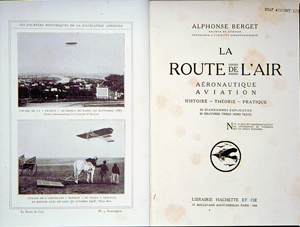
Berget, Alphonse, i.e., Thomas Claude Xavier Alphonse

...La route de l'air; Aéronautique, Aviation, Histoire—Théorie—Pratique. 82 diagrammes explicatifs, 66 gravures tirées hors texte...

Paris:  Librairie Hachette et Cie, 1909. 3 p.l., vi, 311, [1] p. front., illus., plates. 25.5 cm.
TLB251.B49r  1909
Brockett 1593b

Bibliographic note:  This volume is ex libris Horace Oswald Short, with his book-plate.  The Gimbel collection contains another copy of this edition, ex libris Aero Club of America.  The collection also contains several editions of the English translation:  The Conquest of the Air:  Aeronautics, Aviation, History, Theory, Practice, by Alphonse Berget... New York: G. Putnam's Sons;  London: Heinemann, 1909. xxiv, 295 p. illus. (incl. maps) xxxii (i.e., 36) pl. (incl. front.) 23.5 cm.  The collection has twin copies of the 1911 editions:  "New and revised edition," New York: G. Putnam's Sons; London:  Heinemann, 1911. xx, 249 p. illus. 22 cm. In addition, the collection holds:  Alphonse Berget, Ballons, Dirigeables et Aeroplanes. Paris: Librairie Universelle, 1908.  3. p. l., (i.e., iii) 276 p. incl. illus. (incl. ports.) plates (2 double) 19 cm.; L'Aviation, Ballons, Dirigeables, Avions. [Paris]:  Hachette, 1924. 64 p. incl. front., illus., diagrs. 24 cm.;  L'Air ... Illustré Sous la Direction de Lucien Rudaux.  Paris:  Librairie Larousse, [c. 1927]. 310 p. illus. 32 cm.


Alphonse Berget (1860-1934) was one of the leading historians of early aviation. His work remains useful for its insight into the personalities and events of fin de siècle aeronautics.


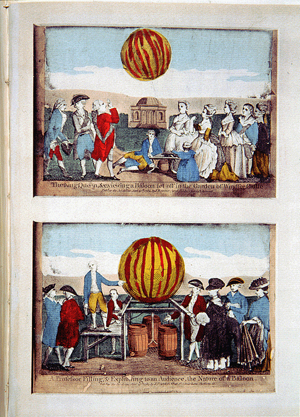
Bruel, François-Louis

Histoire aéronautique par les monuments peints, sculptés, dessinés et gravés des origines à 1830.  Deux cents reproductions en noir et en couleur, text par François-Louis Bruel du Cabinet des Estampes de la Bibliothèque Nationale

Paris:  André Marty, 1909. 4 p. i., [5]-93, [2] p. l. plates (part col., part fold.) ports., facsim., 37.5 cm. x 29 cm.
TLB258.B84
Gamble 170

François-Louis Bruel's (1881-1912) lavishly illustrated Histoire remains one of the great treasures in the history of aeronautical publishing. Covering the period from antiquity to 1830, the volume is filled with a wealth of illustrations, ranging from full-color reproductions of eighteenth- and nineteenth-century prints to a wide variety of other historic works of art. Printed on special papers, using colored inks, and tipped or specially bound into the volume, many of the images are reproduced as virtual facsimiles of the originals. In addition to the thoughtful and very informative text, the Histoire is a master-work of the printer's art.


Douhet, Giulio

Le possibilità dell'aereonavigazione

758-771 p. 26 cm. (In Revista delle Communicazioni. Anno III, Fasc. VIII Roma: Ministero delle Poste e dei Telegrafi, 1910.)
TLB400.D73

Giulio Douhet (1869-1930) was the earliest and most influential of the military officers who came to be identified as "Prophets of Air Power." Born into a family with a tradition of service to the House of Savoy, Douhet developed an early reputation as an officer who was willing to say what he thought and fight for what he believed. Already an authority on mechanized warfare, he emerged as the principal Italian spokesman for the military airplane by 1910. Although he had not yet flown, and had seen only one or two airplanes in the air, Douhet was already expressing the major elements of his airpower theory in the most forceful terms. Command of the air, he argued, would prove just as important as command of the sea.

Italy was the first nation to explore the military role of the airplane. Nine aircraft supported the Italian invasion of Turkish Libya in 1911. This small air unit conducted some of the earliest coordinated reconnaissance and bombing missions in history. Named to command the provisional Italian air battalion prior to the outbreak of World War I, Douhet placed an order for an advanced trimotor Caproni bomber without authorization. In spite of the fact that the big Caproni would eventually become the pride of both Italian and American air units battling Austro-Hungarian forces during World War I, Douhet was removed from his post and sent to an infantry unit. Undaunted, he continued his outspoken attacks on Italian air policy, for which he was court-martialed and imprisoned.

Following his release from prison, Colonel Douhet published a prophetic novel, Come Fini la Grande Guerra—la Vittoria Alata (How the Great War Ended—the Winged Victory). His most important book, Il Domino dell'Aria (Command of the Air), appeared in 1921, with a second edition in 1927. Translated into other languages, the book played an important role in shaping a debate on the potential of the air weapon during the years between the wars.


Trowbridge, John

Darius Green and His Flying-Machine, by J.T. Trowbridge; with illustrations by Wallace Goldsmith

Boston and New York:  Houghton Mifflin Company, 1910. 53, [1] p. incl. front. plates, 16 cm.
PS3097.D21

Bibliographic note:  The Gimbel collection also contains The Vagabonds, and Other Poems.  Boston:  J.R. Osgood, 1875.  Includes Darius Green . . . iv, 172 p. 17.5 cm


During the years following the Civil War, most Americans came to regard the flying machine as the ultimate in foolish dreams. John Townsend Trowbridge (1827-1916) provided a classic statement of this attitude in his poem "Darius Green and His Flying Machine," which may have appeared as a magazine piece as early as 1869. Like many another "country dunce," young Darius was convinced that "the air was also man's domain." Determined to conquer the sky, he sets to work

     ...with thimble and thread and wax and
     hammer and
     buckles and screws,
     and all such things as geniuses use,
     Two bats for a pattern, curious fellows!
     A charcoal pot and a pair of bellows, some
     wire and
     several old umbrellas;
     A carriage cover, for tail and wing, a piece of
     harness, and straps and strings,
     ... these and a thousand other things.

Encased in his contraption, the inventor leaps from the hayloft and falls straight down into the barnyard, surrounded by "a wonderful whirl of tangled strings, broken braces and broken wings, shooting stars and various things." To the thousands of readers who chuckled over poor Darius' plight, the meaning was perfectly clear: "If God had intended for humanity to fly, he would have given them wings."


Bryan, George Hartley

Stability in Aviation; An Introduction to Dynamical Stability as Applied to the Motions of Aeroplanes, by G.H. Bryan. . .

London:  Macmillan and Co., Ltd., 1911. x, il., 192 p. illus., diagrs. 22.5 cm.
TLD491.B91  1911
Gamble 1564


George Hartley Bryan (1854-1928), a professor at the University College of North Wales, was a major first-generation contributor to flight science and technology. The inventors of the airplane were engineers of genius, but they had left a great many questions unanswered. During the first two decades of the twentieth century, German researcher Ludwig Prandtl, based at Göttingen University, addressed fundamental aerodynamic problems and developed the core of a circulation theory of lift. Other pioneering contributors to aerodynamic theory included Wilhelm Kutta, Nikolai Zukovskii, Frederick Lanchester, and a host of Prandtl's students and associates, notably Max Munk and Theodore von Karman.

G.H. Bryan was the most important early contributor to the study of another set of theoretical problems relating to stability and control. Bryan published his earliest article in this field in 1903. Stability in Aviation provided a generation of airplane designers with a solid understanding of issues related to aircraft and control.


Grahame-White, Claude, comp.

The Aeroplane, Past, Present, and Future, by Claude Grahame-White (Winner of the Gordon Bennett International Aviation Cup, 1910) and Harry Harper; with ninety-three illustrations

London:  T.W. Laurie, 1911. 2 p. l., vii-xv, 310.  [1] p. front. plates, ports., fold. tab. 23.5 cm.
TLB251.G74  1911

Bibliographic note:  The Gimbel collection contains two copies of this edition and a third copy marked:  "This edition de luxe consists of 100 copies, numbered and signed.  This is  No. 21."  As noted, the volume is signed and differs slightly from copies of the standard first edition:  xv, 319 p. illus. 23 cm.  The collection also contains a copy of the first American edition:  Philadelphia:  J.B. Lippincott, 1911.  vii-xv, 319 p. illus. 24 cm.

Other volumes by Grahame-White represented in the Gimbel collection include:  The Story of the Aeroplane, by Claude Grahame-White.  Boston:  Small, Maynard and Company, [c. 1911].  xii, 390 p. illus. 21 cm.; Aviation, by Claude Grahame-White.  London, Glasgow:  Collins's Clear Type Press, (pref. 1912).  262 p. front. (port.) 18 cm.; The Invisible War-Plane.  A Tale of Air Adventure in the Great Campaign, by Claude Grahame-White and Harry Harper... London:  Blackie and Son Ltd., [1915]. v, il, 272 p. front. plates. 19 cm.; Learning to Fly; a Practical Manual for Beginners, by Claude Grahame-White and Harry Harper...  London: T.W. Laurie, Ltd., [c. 1916].  111., [1] p. front., plates. 19 cm.


Claude Grahame-White (1879-1959) was one of the great English aviators of the first generation, and Harry Harper one of its first great publicists. Grahame-White earned fame in March and April 1910 when he competed with the French aviator Louis Paulhan for the £10,000 Daily Mail prize for the first flight from London to Manchester. Grahame-White lost the race, but he made the first recognized night flight in Europe during the course of the contest and won the affection and admiration of his countrymen.

Grahame-White toured the United States as well. In spite of being targeted by the Wright brothers for competing for prize money with a machine covered by their American patent, Grahame-White emerged as the star of the Harvard-Boston Meet in September 1910 and won the 1910 James Gordon Bennett International Aviation Cup, staged as part of the great Belmont Park flying meet the following month.

In 1910, Grahame-White and his friend, the aviation enthusiast and publicist Harry Harper, published one of the most popular of all early books on winged flight. The Aeroplane is as much a compendium of essays as an authored work.  Among  the featured sections are a chronology of aviation and a list of records;  short biographies of  the first aviators;  a description and analysis of the earliest aircraft fatalities; a discussion of aircraft engines; a discussion of "the constructional future of aeroplanes" by Henri Farman; C.G. Grey's notes on aircraft safety; and the thoughts of Colonel J.F. Capper on the future of military aviation.


La Vaulx, Henri, Comte de

Le Triomphe de la Navigation Aérienne; Aéroplanes, Dirigeables, Sphériques

Paris:  J. Tallandier, [1910]. 2 p. l., 3-392, [4] p. incl. illus., plates. double pl. 33.5 cm.
TLB251.L39

One of the wealthy sport balloonists who founded the Aéro-Club de France (1898), the Comte Henri de la Vaulx (1870-1930) was a confirmed nationalist who worked to ensure that France, the nation of the Montgolfiers, would lead the world into the air age. As president of the Aéro-Club during the critical year of 1904, he presided over a renaissance of French interest in winged flight following the revelation of what the Wright brothers had accomplished.

The Comte de la Vaulx encouraged experiments with winged aircraft, established prizes to encourage aeronautical achievement, and commissioned the construction of a monoplane based on a design by the nineteenth-century pioneer Victor Tatin, which left the ground on two occasions in 1907. In addition, Comte de la Vaulx produced Le Triomphe de la Navigation Aérienne, a volume that the English authority Charles Harvard Gibbs-Smith regarded as "one of the most authoritative of the early histories of flying"  (The Rebirth of European Aviation [London: PRO, 1974], p. 9).


Appleton, Victor [pseud.]

Tom Swift and His Air Glider, or Seeking the Platinum Treasure

New York:  Grosset & Dunlap, [1912]. iv, 209 p. front. 19.5 cm.
TLB418.A65


Once upon a time in America, Tom Swift was a name to conjure with. Edward Stratemeyer (1862-1930), the publishing giant and "king of the juveniles" who inaugurated the Motor Boys, Rover Boys, and Bobsey Twins series of juvenile novels, also set the Tom Swift saga in motion. As had been the case with earlier book series back to the time of Samuel Goodrich, Stratemeyer conceived the character, established the basic formula, and farmed out the writing chores. All of the Tom Swift volumes appeared under the name of Victor Appleton, although author Howard Garis wrote most of the books.

The formula seldom varied. Tom, the son of a widowed inventor, with the assistance of a standard group of friends, supporters, and comic foils achieves yet another technological triumph in order to defeat the latest scheme of the "Happy Harry Gang," rival inventor Addison Berg, or Andy Foger, "a red-headed, squint-eyed rich bully" determined to steal Tom's latest invention.

The most successful of all Stratemeyer's creations, Tom Swift books continued to appear for over a decade after his death. The forty titles published between 1910 and 1941 sold an estimated 6.5 million copies. In spite of the best efforts of school librarians who decried their literary shortcomings, the books had an enormous impact. The indomitable young hero, ever ready to overcome the most daunting problem with yet another breakthrough, helped to inspire generations of American youngsters with faith in the power of the machine.
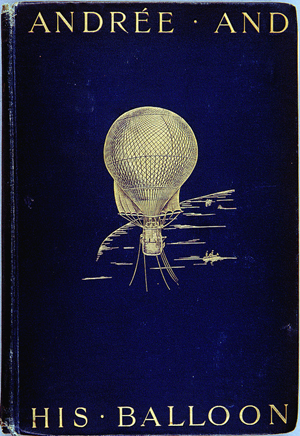

Curtiss, Glenn Hammond

The Curtiss Aviation Book, by Glenn H. Curtiss and Augustus  Post; with chapters by Captain Paul W. Beck, U.S.A., Lieutenant Theodore G. Ellyson, U.S.N., and Hugh Robinson; with numerous illustrations from photographs

New York:  Frederick A. Stokes Company, [c. 1912]. 3 p. l., v-x, 307 p. front., 1 illus., plates, ports., diagrs. 20 cm.
TLB400.C98

Glenn Hammond Curtiss (1878-1930) loved speed above all things.  As a young man, he raced bicycles, then built and raced motorcycles. The sale of a motorcycle engine to power an airship operated by Thomas Scott Baldwin (1864-1923) marked Curtiss' entry into aeronautics. In 1908, he provided the power plant for the SC-1, the first U.S. Army airship, designed and built by Baldwin.

As early as 1907-1908, Curtiss joined forces with Alexander Graham Bell, Lt. Thomas E. Selfridge, J. McCurdy, and F.W. Baldwin to form the Aerial Experiment Association (AEA). The AEA produced a series of machines, culminating in the June Bug, which won the Scientific American trophy for the first public flight in the United States of about half a mile or more (July 4, 1908).

In the summer of 1909, Curtiss won the first James Gordon Bennett International Aviation Cup, which was awarded for a speed contest staged at the great flying meet at Reims, France. Curtiss was not the first to fly off water, but he did become the world's best-known and most successful builder of flying boats. Curtiss aircraft were also the first to take off from and land on ships. Moreover, the early successes chronicled in the Curtiss Aviation Book were achieved while Curtiss was the target of the most important of the lawsuits brought by the Wright brothers against those whom they regarded as having infringed their patent.

Within two years of the publication of this volume, the Curtiss Aeroplane and Motor Company would become the most successful of all U.S. aircraft manufacturers. The firm was the leading supplier of flying boats to the navies of the world, the designer and builder of a flying boat thought capable of flying the Atlantic, and the leading U.S. supplier of aero engines and training aircraft. Curtiss had become one of the great names in American aviation, and so it would remain.


Conneau, Jean Louis Camille

My Three Big Flights, by André Beaumont (Lieut. J. Conneau) with a sonnet by Edmond Rostand and sixty illustrations

New York:  McBride, Nast & Company, 1912. x1, 150 p. front., plates, ports. 23.5 cm.
TLB290.C75


During a three-month period in the summer of 1911, Jean Conneau, an ensign in the French navy who flew (and wrote) under the name of André Beaumont, won three of the great aerial competitions of the prewar era: the Paris-Rome Race (May 28-31); the Circuit of Europe (June 18-20); and the Circuit of Britain (July 22-24). Conneau immediately began work on a series of lectures and a book, both of which would be illustrated with his photographs.

Conneau's book, which includes a poem by Edmond Rostand, is one of the great personal accounts of the period. The aviator offers considerable insight into the problems of operating the aircraft of the time, including the difficulties of point-to-point navigation. Having made his name as a racing pilot, Conneau returned to duty with the French navy, where he pioneered operations with the Donnet-Leveque biplane, a Curtiss-style flying boat.


[Lewis, Sinclair]

Hike and the Aeroplane, by Tom Graham [pseud.]; with illustrations in two colors by Arthur Hutchins

New York:  Frederick A. Stokes & Company, 1912. 6 p. l., 275 p. col. front., col. plates. 19.5 cm.
TLB418.L676h

"You're damn right," Sinclair Lewis (1885-1951) explained to Chauncey Tinker in 1938, "I wrote Hike and the Aeroplane for the sole and not very commendable purpose of getting from the firm of Frederick A. Stokes & Company, who paid outright for the book at salary rates, a long vacation to do a few words on my first novel, Our Mr. Wren." Although the first American Nobel laureate in literature may not have been especially proud of the fact, Hike and the Aeroplane, not Our Mr. Wren, was his first published novel.

Written during a three-week stay at Provincetown, Massachusetts, in 1911, the book is a straightforward boy's adventure story of the Tom Swift variety in which Hike, the 16-year-old hero, makes use of an airplane to triumph over the evil Captain Welch. Fascinated by aviation, Lewis had already published a short story ("Captains of Peace") based on an aeronautical theme.  Lewis informed his friend Gene Baker that three well-known aviation pioneers—Glenn H. Curtiss, J.A.D. McCurdy, and U.S. Army pilot Capt. Paul Beck—had read and approved the manuscript of the novel. "But that ain't no sign," he concluded. "Since when were aviators established as the perfect court of literary judgment?"
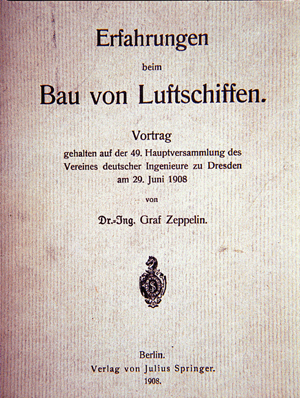
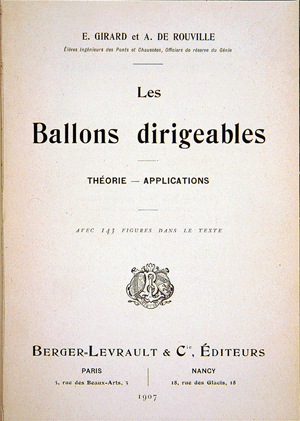

Wright, Orville

How We Invented the Airplane

Edited and with commentary by Fred C. Kelly, Drawings by James MacDonald.  New York: McKay, 1953.  78 p. illus. 18 cm.
TLB251.W95h

Neither Wilbur nor Orville Wright was ever able to write a detailed account of their work in aeronautics. During their lifetimes, the full story of what they had achieved remained locked away in their letters, diaries, and notebooks. Both men did tell their story in several major court depositions, however. Orville Wright offered a particularly clear and concise account on January 13, 1920, when he testified as a government witness in the case of Montgomery v. The United States. The suit was brought by individuals who argued that in supporting the patent claims of the Wright brothers and others the government had unfairly ignored the prior claims of John Joseph Montgomery, a California aeronautical pioneer. The Montgomery heirs lost their case, but Fred Kelly, a journalist and official biographer of the Wrights, edited the testimony that Orville offered on that occasion and published it as a short book that remains the best first-person account of the invention of the airplane.


McFarland, Marvin W., ed.

The Papers of Wilbur and Orville Wright, including the Chanute-Wright letters and other papers of Octave Chanute

New York:  McGraw-Hill Co., 1953. 2 v. 1 v., 1,278 p. illus., ports., facsims., 24 cm.
TLB290.W95


Few, if any, major episodes in the history of technology are as well documented as the invention of the airplane. The letters, diaries, notebooks, photographs, and other original documents preserved by the Wright brothers represent a remarkably complete record of their achievement. In crafting an agreement transferring the priceless Wright manuscript collection to the Library of Congress in 1949, the executors of Orville Wright's estate suggested that "it would be desirable" to compile and publish the most important documents in order to produce "a comprehensive record of the Wright brothers and their work."

Wisely, the leadership of the Library of Congress placed Marvin W. McFarland in charge of the project. McFarland, who had served as a U.S. Army Air Forces historian in uniform during World War II, decided to follow the example of those who handled presidential papers, publishing the most important documents in the collection in a scholarly edition complete with extensive notes, appendices, and illustrations. McFarland and the members of his small team began work in the late spring of 1950. The result, nothing less than a masterpiece of historical scholarship and editing, was published on the occasion of the fiftieth anniversary of powered, heavier-than-air flight.