The Colonel Richard Gimbel Aeronautical History Collection

Printed Books  1489 – 1850


Narration By Will Ketterson

Introduction By Clive Hart

The Colonel Richard Gimbel Aeronautical History Collection is especially valuable in containing items that bear on the very early history of aviation in a wide variety of ways. In addition to rare books and pamphlets from the time of the first balloon ascents and tracts offering designs for heavier-than-air machines, there are books of flying legends (many of them attractively illustrated), imaginative tales in both verse and prose of voyages to the moon and planets, books of scientific theory and quasi-scientific speculation, treatises on the flight of birds, and works of angelology that examine the human aspiration to flight from the point of view of religious belief.

The diversity of the collection greatly facilitates the wide-ranging interdisciplinary studies that are necessary if the technological achievements of the early modern period are to be properly understood. The development of winged aircraft was delayed not only by inadequate technology and the failure of all experimenters before the nineteenth century to understand the basis of bird flight but also by the deep-seated unease of many thinkers. The doubts of philosophers and theologians and the generally negative response of the early Christian church had a notable effect on the speculators. Although flying prophets and other men of virtue figure frequently in pagan myth and religion, early Christianity wished to reserve almost all virtuous flight for the seraphs. Ordinary angels were not represented as winged until some centuries after Christ. For Christians, flight through the atmosphere was most clearly associated with demons, sorcerers, and (later) witches. (Contrary to popular opinion, witches were an obsession of the Renaissance rather than of the Middle Ages.) Satan was “the prince of the power of the air” (Ephesians 2:2) and any man who aspired to fly might be thought potentially in league with him. At times more positive effects of Christian thought and iconography can nevertheless be perceived: the joyous story of the aerial journey of Mary's house in Terameno's little tract (see Terameno, Translatio, ca. 1495) caught the imagination of designers of large machines.

The collection includes many books of importance not described here. There are early editions of John Donne, John Milton, Ovid, Johannes Sambucus, and Alfred Tennyson, all of scholarly and bibliographical interest. Early and rare books on fireworks bear on the history of rocketry. There are works by the British astronomer Sir John Frederick Herschel and other important astronomers and scientists. The shelves also hold a large number of items from among the thousands of publications that appeared in the two or three years following the first ascent in a Montgolfier balloon in 1783. These include not only the best-known books and pamphlets in French and English but also an especially rich collection of publications in Italian. Together with these is a large and valuable collection of the many satirical plays, vaudevilles, squibs, and broadsides published, mainly in French, in the years immediately following the Montgolfiers' success. (Perhaps the only collection to rival the Gimbel in that respect is the Bibliothèque de l'Arsenal, Paris.) The books described in this section and those in the Appendix inevitably represent no more than a sample. Although I have tried to identify items that reveal the special qualities of the Gimbel collection, other choices could readily have been made.

*   *   *

Following the standard bibliographic data for each item in this and the next section (Printed Books, 1851-1914), the Gimbel collection call number is identified. Additionally, where appropriate, references are given to corresponding entries in such standard bibliographies as Hain, Brockett, Gamble, and Randers-Pehrson (the last coded R-P) listed in the “Printed Books, 1489-1850” section of the Bibliography of this program. For books published before 1701, numbers are given for the Pollard or Wing short-title catalogues coded STC and also listed in the Bibliography.  If an entry in the Bibliography refers not to the holding in the Gimbel collection but to a closely related book or edition, the number is placed in brackets. Finally, and again where appropriate, other copies and editions in the Gimbel collection of the item described are noted. Thus for Historia Alexandri, the first item described in this section, the Gimbel call number is AC10.A4 1489, and “Hain 780” refers to the number of the relevant entry in Ludwig Hain, Reportorium bibliographicum. 4 vols. Stuttgart and Paris, 1826-1838 (listed in the Bibliography of this program).


Alexander the Great (romances, etc.)

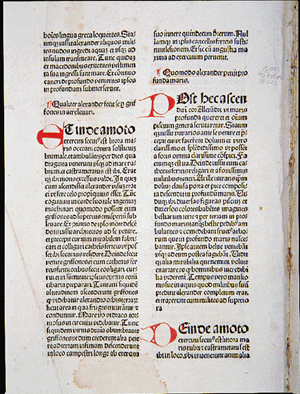
Historia Alexāndri | magni regis | mace | donie de prelijs.

Colophon: Historia Alexandri magni finit feliciter impressa Argentine anno domini M.CCCC.LXXXIX.

37 leaves. 28.5 cm.
Title-page with verso blank. Illus. Of king on t.-p.
Signatures: a4-f4, [g1]. Printer: Johannes Gruninger. AC10.A4 1489
Hain 780

The romance of Alexander, a fabulous account of the life of Alexander the Great (356-323 B.C.E.), was immensely popular in the Middle Ages and the early Renaissance. Alexander not only conquered all known countries on land but also used a primitive submarine to explore the bottom of the sea and a flying machine to carry him through the regions of the air. His machine, illustrated in this and many other medieval manuscripts, consisted of a basket to which two or sometimes four griffins were tethered. Alexander held a dead carcass on a pole. When he raised the carcass above the griffins' heads, they attempted to fly up to it and so carried the basket through the air. When Alexander wanted to descend, he lowered the pole to make the griffins fly down. The land and sea below Alexander are described as if on a large map. Offended by Alexander's presumption, divine power finally caused the griffins to think they were rising when in fact they were descending. The machine, which was damaged when it landed, came down fifteen days' walk from Alexander's army, thus complicating Alexander's return. Along with the story of Icarus (see below, Riedrer, Spiegel, 1493), this is among the most frequently quoted cautionary tales about the consequences of excessive ambition. (The story is told on fol.f2v of this printing of the book.)


Riedrer, Friedrich

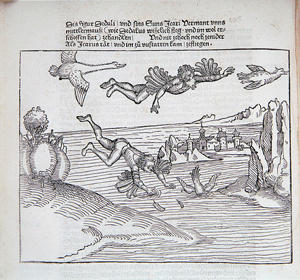
Spiegel der waren Rhetoric | vsz M. Tulio C. vnd andern | getütscht: Mit Irn glidern cluger reden | Sandbriefen, vnd formen.  Menicher con | tract, seltzam. Regulierts Tütschs  vnd | nutzbar exempliert, mit fügen vff | göttlich vnd keiserlich schrifft | göttlich vnd keiserlich schrifft vnd rech | te gegründt: nuwlich (vnd vormaln | In gemein nÿe gesehen) ÿetz loblich vsz | gangen. [fol. 188r:] friburg in Briszgaw, Durch fridrichen Riedrer versamelt, gedruckt, vnd volendet . . . An mittwoch vor sant Lucien tag [11 December] 1493.

[188] leaves, 2-180 so numbered. 31 cm.
With several woodcuts, incl. t-p; fall of Icarus on fol. 61v.
AC10.R4 1493
Hain 13914


Although illustrations of flying men had long been common in manuscripts and other media, Albrecht Dürer's woodcut in Riedrer's Spiegel is the first such representation in a printed book. The story of the flight of Daedalus and his son Icarus was best known from a passage in Ovid:

he lays feathers in order, beginning at the smallest, short next to long, so that you would think they had grown upon a slope. Just so the old fashioned rustic pan-pipes with their unequal reeds rise one above another. Then he fastened the feathers together with twine and wax at the middle and bottom; and, thus arranged, he bent them with a gentle curve, so that they looked like real bird's wings.

Using these wings, Daedalus and Icarus flew away from captivity but "led by a desire for the open sky," Icarus flew too high. "The wax melted; his arms were bare as he beat them up and down, but, lacking wings, they took no hold on the air" (Metamorphoses, VIII. 189-195, 224, 227-228).

Dürer makes an ironic parallel between Icarus' fall into an element to which he is physically unsuited and the entirely natural dive of the seabird to his left. Variants of the old adage "if God had meant us to fly, He'd have given us wings" were often invoked in response to early attempts to build flying machines.


[Terameno, Pietro]

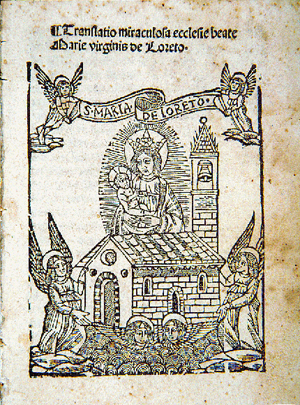
Translatio miraculosa ecclesie beate | Marie virginis de Loreto.  [Romae, Eucharius Silber, ca. 1495]

4 leaves. 14 cm.
Title vignette: church being transported by angels, with Madonna above.
Ms. notes.
1. Mary, Blessed Virgin, Saint—Early works to 1800.
AC10.T7 1495
Hain-Reichling, Appendices 1884

This little tract, hugely popular during the Renaissance, was reprinted many times and translated into several languages. After the Reformation, its Marian theme made it wholly unacceptable to Protestants. Two different translations of modified versions of the original, both by R. Corbington and both printed in 1635, were nevertheless widely circulated among English recusants during the seventeenth century. Facsimiles of the translations were published as folded broadsheets at the back of D.M. Rogers, ed., English Recusant Literature, 1558 - 1640 vols. 75 (1971) and 108 (1972).

According to the legend, in 1291 angels transported the Virgin's house from Nazareth through the air and deposited it in Loreto to protect it from invading infidels. The story serves in part to counter pagan stories of mystical flight, such as an oracle that flies after being lifted by priests in Lucian's De Syria dea (sect. 37). Images of the flying house—including frescos, sketches, and paintings by Tiepolo (1692-1769)—are common. 

In Catholic countries the story strongly influenced later speculations about the relationship between the flight of angels and their power to move material objects. In this vignette they are carrying the house without effort through the upper air, above the clouds. This region was thought to be one of total serenity; if human beings could reach so high, they too, would be able to move objects without muscular effort. Together with Saint Joseph of Copertino (1603-1663), Mary is one of the patron saints of aviators.


Cælestinus, Claudius

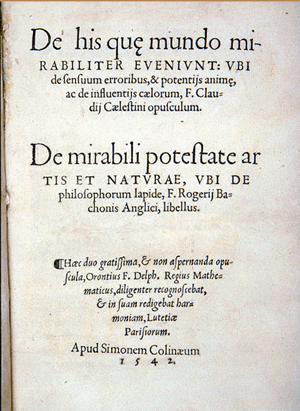
De his que mundo mirabiliter enenivnt: vbi de sensuum erroribus, & potentijs anime, ac de influentijs cælorum, F. Claudij Cælestini opusculum.  De mirabili potestate artis et natvrae, vbi de philosophorum lapide, F. Rogerij Bachonis Anglici, libellus.  Hæc duo gratissima, & non aspernanda opuscula, Orontius F. Delph.  Regius Mathematicus, diligenter recognoscebat, & in suam redigebat harmoniam.  Lutetiæ Parisiorum Apud Simonem Colinæum, 1542.

[4], 52 p. 21 cm.
1. Science—Early works to 1800. I. Bacon, Roger, 1214?-1294. II. Fine, Oronce, 1494-1555. III. Title. IV. Title: De mirabili potestate artis et natvrae.
Q155.C13
[Gamble 4678, 4679]

An important contributor to medieval science, Franciscan monk Roger Bacon was somewhat irascible and prone to hyperbole. In De mirabili potestate artis et natvrae, written about 1260, he alleged that "it is possible to make flying machines such that a man may sit in the middle of the machine turning some kind of device by means of which artificially constructed wings strike the air in the manner of a flying bird." Speaking of this and a number of other mechanical devices, he goes on to say that it is certain that they were made both in ancient times and in modern, with the possible exception of the flying machine, which he has not seen, nor does he know anyone who has seen such a thing. He does, however, claim to know a man who has thought through the art of building one. In medieval times it was common to believe that the achievements of the classical world—mechanical as well as moral—surpassed those of the civilizations of the day. The conviction that in those times men had solved the problem of flight inspired many experimenters.


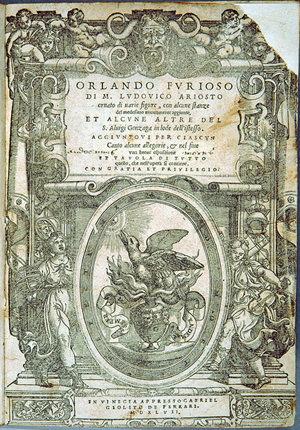
Ariosto, Lodovico, 1474 - 1533

Orlando Fvrioso di M. Lvdovico Ariosto ornato di uarie figure, con alcvne stanze del medesimo nuouamente aggiunte, et alcune altre del S. Aluigi Gonzaga in lode dell'istesso. . . In Vinegia appresso Gabriel Giolito de Ferrari, 1547.

264, [30] numb. leaves, illus. 21 cm.
"Espositione di tvtti i vocaboli e lvoghi difficili . . . raccolte da M. Lodovico Dolce . . ." (leaves [1-25] has special t.-p.).
With bookplates of Thomas Isted and C.W.H. Sotheby.
Printer's device (phoenix on pyre staring at the sun with motto semper eadem) on t.-p.s and last p.    
PQ4567.A2 1547

Other copies and editions in the Gimbel collection: PQ4567.A2 1572: Orlando Fvrioso . . . tvtto ricorretto. . . , illus. with woodcuts attrib. to Dosso Dossi (d. 1542), Venetia, 1572; PQ4582.E5 A35: Orlando Furioso, trans. from the Italian. . . with notes by John Hoole, 5 v., illus., London, 1799.


One of the greatest Italian writers of the Renaissance, Ariosto wrote plays that imitated those of Plautus and Terence and lyric poems in both Latin and Italian. His fame, however, rests almost entirely on Orlando Furioso, a long and complex romance in forty-six cantos, the first version of which was published between 1516 and 1532. Among its many episodes is the story of how Astolfo flies to the moon in aid of Orlando, whose "wit" (rational faculty) had been taken from him and deposited there three months earlier. To reach the moon, Astolfo first rides on his winged horse, the offspring of a griffin and a mare, and then in the chariot of Elijah (2 Kings 2:11) with Saint John the Evangelist as charioteer:

...to the Moone he guides the running wheel, The Moone was like a glasse all void of spot, Or like a peece of purely burnisht steel, And look'd, although to us it seem'd so small, Wel-nigh as big as earth and sea and all.

– (Canto 34.70.4-8, in Sir John Harrington's translation of 1591).

Astolfo returns safely with the "wit" and restores Orlando to mental health. In 1784 Vincent Lunardi was to propose that Astolfo's flight was a hint that the principle of the balloon had long since been discovered. (See Lunardi, An account, 1784, p. 28n.)  Ariosto's is one of the many stories of journeys to the moon that proliferated in the literature of the late Middle Ages and the Renaissance. As later holdings in the Gimbel collection reveal, these became still more numerous after the observations of the moon made with the telescopes of Galileo and others.


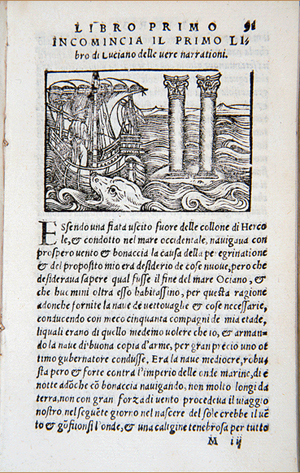
Lucianus Samosatensis, ca. C.E. 135 – 190

I dialoghi piacevoli, le vere narrationi, le facete epistole di Luciano philosopho.  Di greco in volgare tradotte per M. Nicolo da Lonigo: & historiate, & di nuouo accuratamente reuiste, et emendate.  In Venetia, per G. Padoano, 1551.

223 numb. 1. illus. 15 cm.
With 30 woodcuts.  Bound in vellum.
Bookplate of George Charles Bright, M.D.
I. Lonigo, Nicolò  da, tr.
PA4231.A2 1551
[Gamble 80]

Other copies and editions in the Gimbel collection: PA4232.F8 1613: in Les oeuvres, with 10 vignettes on t.-p., Paris, 1613; PA4236.G3P: Lucian's Werke, übersetzt  von August Pauly, Stuttgart, 1829 (v.10 of set only); PA4230.A2F13: in Lucian: with an English Translation, 8 v., Loeb Classical Library, 1913-1967.

In classical literature voyages away from the surface of the earth, both to Hades and to Heaven, were relatively common, among the most celebrated and amusing being the dramatic visit to an aerial civilization in Aristophanes' play The Birds (414 B.C.E.).  Better known among readers of the Renaissance, however, were two journeys described by the Greek poet Lucian. The more familiar of these is his satire Icaromenippus, the hero of which travels to the heavens in search of truth. The other is a story in this "true history," which is in fact a parody of travelers' tales. Lucian tells us, tongue in cheek, that he made an involuntary journey to the moon when he was traveling beyond the Pillars of Hercules (the Straits of Gibraltar). 

In the translation by Francis Hicks (1634) Lucian describes how "upon a suddaine a whirlewinde caught us, which turned our shippe round about, and lifted us up some three thousand furlongs into the air." After a week without sight of land, they "came in view of a great countrie in the aire, like to shining Island." He proceeds to describe the inhabitants and their surroundings in terms intended as a satirical commentary on life in Rome.


Philostratus, Flavius, ca. C.E. 170 - 245

Philostrati Lemnii senioris historiæ de vita Apollonij Tyanei libri octo...Lvtetiae, Apud Gulielmum Cauellat, 1555.

16 p.1., 571 p. 11.5 cm.
1. Apollonius, of Tyana. I. Title: De vita Apollonii Tyanei.
TLB154.P5  1555

Appolonius of Tyana (in Cappodocia, an ancient name for a district of what is now Turkey) was a peripatetic philosopher and mystic, born about the time of Christ. The accounts of his magical powers gained him such fame that he was treated by pagans, both in his own day and for some time thereafter, as a god to be revered in direct competition with the claims that were being made for Christ by the early church. The story of his life was written in Greek by Flavius Philostratus (second to third centuries C.E.).  Like many mystics, of whom Simon Magus is perhaps the best known, Apollonius was credited with being able to fly (see Book VII, chap. x). Although the ability to fly was a standard attribute of virtuous pagan mystics, any flying human being was, in the apprehension of Christians, almost certainly in league with demonic powers.  (See introduction to this section.)


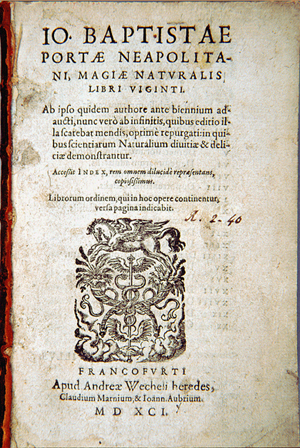
Porta, Giovanni Battista della, 1535? - 1615

Io. Baptistæ Portæ neapolitani, Magiæ natvralis libri viginti...Francofvrti, Apud A. Wecheli heredes, C. Marnium, & I. Aubrium, 1591.

[36], 669 p. 17 cm.
Index on first [36] p. Publisher's device on t.-p.
1. Science—Early works to 1800. I. Title: Magiæ naturalis libri viginti.
Q155.P83 1591
[Gamble 4985]

First published in 1558 when Porta was in his early twenties, Porta's book was reissued in greatly expanded form in 1589 and reprinted several times thereafter. It became one of the best known and most frequently quoted collections of "natural wonders." On pp. 69-70 of the first edition (pp. 668-669 of this edition) he describes how to make a draco volans (flying dragon: the ordinary Latin term for a paper kite, which he believes to be the probable reality behind the wooden dove of Archytas; see Kircher, Magnes, 1641). The passage was influential in spreading knowledge of how to build and fly a diamond-shaped kite of the kind that returning sailors had recently introduced into Europe from the East Indies. Among other writers to quote the description was Johann Jacob Wecker (1528-1586), a copy of whose Les secrets et merveilles de natvre is in the Gimbel collection (the quote is found on pp.1219-1221 of Wecker). This design quickly ousted the more complicated native European kite (which was indeed shaped like a dragon) and eventually played its part in the development of the airplane, especially with the aerodynamic experiments of Sir George Cayley in the early nineteenth century.


Veranzio, Fausto, bp., 1551 - 1617

Machinæ novæ Favsti Verantii siceni.  Cvm declaratione latina, italica, hispanica, gallica, et germanica.  Venetiis [ca. 1595].

1 p. 1., 49 pl. (double pages) 19,18 p. 38 cm.
     1. Mechanical engineering—Early works to 1800.
     2. Machinery—Early works to 1800.
     3. Parachutes. 4. Inventions. I. Title.
TJ144.V47
Gamble 2527


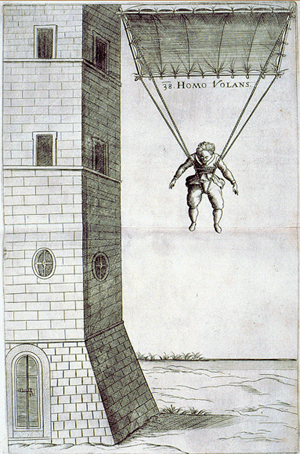
The earliest Western drawing of a parachute is probably that found in British Library Add. MS 34113, fol. 200v, dated about 1480 and very likely antedating Leonardo's famous design of about the same date. Whether Veranzio could have known of either of  these manuscript sketches is uncertain. In any event, the parachute reproduced here is the first to have appeared in a printed book. Like Leonardo's, it uses a rigid rectangular frame, though unlike Leonardo's pyramidal design the canopy is very flat—so flat as to be unstable. The illustration is in any case rather schematic: the uncomfortably harnessed parachutist, whose tunic is quite unruffled, is dropping very slowly. This design appears to have had little if any effect on later inventors. The first recorded free fall by a human being using a parachute was not made until André Jacques Garnerin descended from a balloon on October 22, 1797


Mirrour for Magistrates

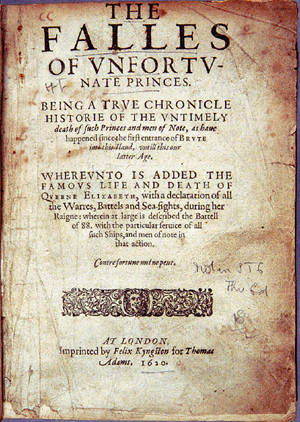
The | falles | of vnfortv- | nate Princes. | Being a trve chronicle | historie of the untimely |death of such Princes and men of Note, as haue | happened since the first entrance of Brvte | into this Iland, vntil this our latter Age. | Wherevnto is added the | famovs life and death of | Qveene Elizabeth, with a declaration of all | the Warres, Battels and Sea-fights, during her | Raigne: wherein at large is described the Battell | of 88. with the particular seruice of all | such Ships, and men of note in | that action. . .  At London, | Imprinted by Felix Kyngston for Thomas | Adams, 1620.

Originally published ca. 1555, but suppressed; a first part covering the earliest period was added later; this edition adds A winter nights vision and Englands Eliza. The three parts have separate title pages: The Variable Fortvne and Vnhappie Falles Of Such Princes As hath happened since the Conquest, 1609; A Winter Nights Vision, 1610; Englands Eliza, 1610.
1. Gt. Brit.—Hist.—Poetry. I. Niccols, Richard, 1584-1616. II. Baldwin, William, fl. 1547. III. Higgins, John, fl. 1570-1602. IV. Title.
PR2199.M67  1620

[Not in STC.  This edition appears to be a reissue, with new t.-p., of the edition of 1610: STC 13446.]


A legendary king of England, Bladud was supposed to have lived in the middle of the ninth century B.C.E. The story of his death was repeatedly cited in Renaissance England as an example of punished hubris. Accounts of his life vary. The founder of the city of Bath, Bladud is said either to have given healing power to the waters by means of spells and mechanical arts or to have been banished as a leper and to have discovered their curative qualities when wandering as a swineherd in 863 B.C.E. The former version is more commonly found. The Mirrour for Magistrates (an anthology of historical narratives) represents him as a kind of British Daedalus, master-inventor. He is said to have died when hoping once too often to outwit nature. Having attached feathers to his body and wings to his arms, he tried to fly from the top of the temple of Apollo but fell onto the building and broke his neck. The limp verse in the Mirrour implicitly Christianizes the story by saying that he flew from the top of the "temple" but fell onto the "church." This is one of many medieval and Renaissance moral tales of men who died or were maimed as a result of their arrogant attempts to fly with wings. Because of Bladud's association with Apollo, he was sometimes identified with the flying prophet Abaris.

The Mirrour for Magistrates was reprinted in many variant forms after its first (suppressed) printing in the mid-1550s. The first extant edition is dated 1559. Despite its very uneven literary quality it was enormously popular.


Kepler, Johannes, 1571 - 1630

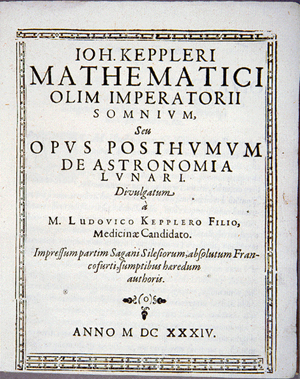
Ioh. Keppleri mathematici olim imperatorii Somnivm, seu opvs posthvmvm de astronomia lvnari. Divulgatum à M. Ludovico Kepplero filio, medicinæ candidato. Impressum partim Sagani Silesiorum, absolutum Francofurti, sumptibus hæredum authoris, 1634.

2 p. l., 182, [2] p. diagrs. 19 x 15.5 cm.
1. Astronomy—Early works to 1800. I. Kepler, Ludwig, 1607-1663. II. Title: Somnivm. III. Title: De astronomia lvnari.
QB41.K38   1634

Kepler's Somnium is a dream-story (sometimes a nightmare-story) of a trip to the moon. Although containing supernatural elements, it is in many respects a fictionalized autobiography in which Kepler's mother figures as a white witch who knows how to transport the dreamer to the moon. Not printed until four years after the death of the author, the Somnium had already been circulating widely in manuscript and had caused the family much trouble: Kepler's mother was almost burned at the stake. The story is important in the history of science fiction. Although a journey to the moon had long been a standard narrative episode, Kepler's differed from most in combining an imaginative tale involving magical potions and strange events with a description of the moon and its inhabitants based on scientific observation and measurement. The Somnium comments on the lessening of the force of gravity as one moves away from the surface of earth and on the difficulty of breathing in rarefied air. Kepler speculates that there is life on the moon, but he does not assume that the inhabitants have humanoid characteristics. Instead, they are akin to dinosaurs and lack any aspects of civilization.


[Wilkins, John, bp. of Chester] 1614 – 1672

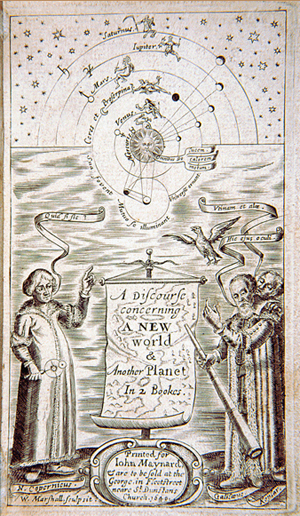
...A discourse concerning a new world & another planet. In 2 bookes.  London, Printed for Iohn Maynard, 1640.

2 v. in 1. illus., diagrs. 17.5 cm.
Engraved t.-p. Each volume has also special t.-p. Pages 221-222 wanting in v. 2.

1. Astronomy—Early works to 1800. I. Title.
QB41.W68  1640
STC 25640.5; [Gamble 5075]

Other copies and editions in the Gimbel collection:  QB41.W68  1638:  The discovery of a world in the moone, [1st ed.]  London, 1638; QB41.W68   1684: 4th ed. "corrected and amended," London, 1684; QB41.W68   1684a: 5th ed., London, 1684; QB41.W68:  Le monde dans la lvne, trans. le Sr de la Montagne, Rouen, 1655, with engraved t.-p.; QB41.W68  1656: another ed. of the previous item, Rouen, 1656.

A man of wide general learning, Wilkins was made Master of Wadham College, Oxford, in 1648, presiding over the university's Philosophical Society. Later he was to be an important member of the Royal Society. A writer of elegant prose, he was keen to remain in touch with the latest discoveries in science and was well equipped to write works of "high popularization" such as his Discovery. Appearing at a time when fictional accounts of the moon were growing common, this book turns to (probable) realities.

Soon after its first publication in 1638, Wilkins revised the book, adding a substantial final chapter on the proposition that "tis possible for some of our posteritie, to find a conveyance to this other world." Having read Kepler's Somnium and other contemporary moon-journeys, Wilkins attempts to answer the scientific questions raised by them. Confident that human flight was possible, even though "it may seeme a terrible and impossible thing ever to passe through the vaste spaces of the aire," he commented that future ages would take flight for granted. He discussed problems related to gravity, to the density of the air, to the cold of the upper atmosphere, and  to the probable distance of the moon from the earth. He calculated that distance as 179,712 miles, which is of the right order of magnitude. The figure was repeated as established fact by many later writers. A practical scientist, Wilkins also gave serious thought to the physical circumstances of life during the journey: as there are no airborne inns, how will the travelers eat, how will they overcome the intolerable boredom of the trip, when will they sleep?


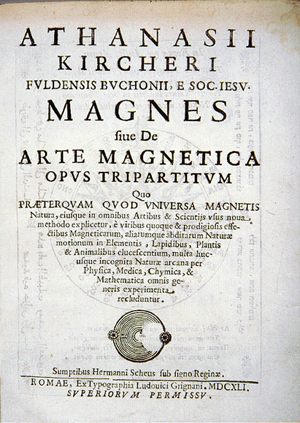
Kircher, Athanasius, 1602 - 1680

...Magnes, siue De arte magnetica opvs tripartitvm. . .sumptibus Hermanni Scheus. . ., Romae, Ex typographia Ludouici Grignani, 1641.

15 p. 1., 916,  [16] p. illus. 25 cm.
1. Magnetism—Early works to 1800. I. Title.
Q155.K58

Other copies and editions in the Gimbel collection:  Q155.K58  1654:  3rd ed. "ab ipso authore recognita," Romæ, 1654.

A voluminous writer who combined true scientific curiosity with credulity and a vivid imagination, the Jesuit priest Kircher caught the imagination of many readers with his book on magnetism (reprinted in 1643 and 1654). Writing first of the natural, observable qualities of the magnet, he then proceeds to more recondite matters, including magnetic hydromancy and oneiromancy. In an engraving opposite p.358 he illustrates his explanation of the wooden dove of Archytas. According to Aulus Gellius (second century C.E.), Archytas of Tarentum, a friend of Plato (fourth century B.C.E.), built and flew a wooden dove, "so nicely balanced was it, you see, with weights and moved by a current of air enclosed and hidden within  it" (Noctium atticarum libri xx, X.12.8-10; see Appendix). Writers of the Renaissance frequently discussed the true means by which this bird might have flown.  Kircher says that it must have been propelled by hidden magnets and a wire so fine as to escape detection. The Latin caption beneath the engraving says, "Neither a wheel, nor a wind but a magnet enables the device to move." Scientists were often fascinated by the practical uses to which they thought the somewhat mysterious power of the magnet might be put.

The wooden dove of Archytas continued for centuries to encourage inventors to build flying models. Among the most interesting is a design by Erasmus Darwin, grandfather of Charles, for a model goose (1777).


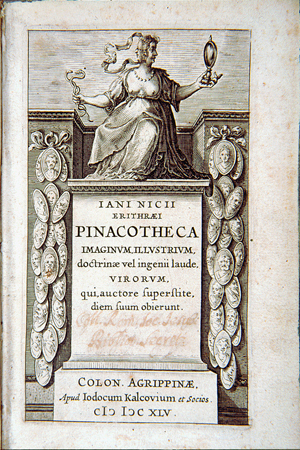
Rossi, Gian Vittorio, 1577 - 1647

Iani Nicii Erithrœi Pinacotheca imaginvm, illvstrivm, doctrinœ vel ingenii laude, virorvm, qui, auctore superstite, diem suum obierunt. Colon. Agrippinæ Apud Iodocum Kalcovium et Socios, 1645.

2 v. in. 1. port. 15.5 cm.
1. Biography—17th century. I. Title: Pinacotheca imaginum, illustrium.
CT93.R82

One of Rossi's "illustrious men" is the painter, sculptor, and architect Paolo Guidotti, who was born in Lucca in 1569. Guidotti was a man of many talents: in addition to being a skilled visual artist he was a musician, poet, and doctor of laws. Toward the end of the sixteenth century he decided to try to add human flight to his other achievements. He accordingly made wings from whalebone held in shape with springs and covered with feathers. These he fixed under rather than on top of his arms, thus ensuring further rigidity. With this equipment he threw himself from a height and seems to have managed a short glide, which one sober-minded witness described as more like a controlled fall than a flight. The attempt ended when he crashed through a roof and landed on the floor of the room below, breaking his thigh. The date of this attempt is unknown. One account says that it was as late as 1628, but Guidotti was then 59 years old and unlikely to have engaged in such vigorous activity at that age.


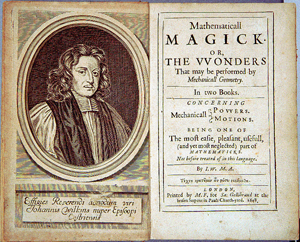
Wilkins, John, bp. of Chester, 1614 - 1672

Mathematicall magick.  Or, The wonders that may be performed by mechanicall geometry.  In two books.  Concerning mechanicall powers [and] motions.  Being one of the most easie, pleasant, usefull, (and yet most neglected) part of mathematicks.  Not before treated of in this language. By I.W., M.A. London, Printed by M.F. for S. Gellibrand, 1648.

7 p. 1., 295 p. illus., diagrs. 16.5 cm.
1. Mechanics.
QC123.W68   1648
[Brockett 12900]; [Gamble 5076]; Wing W2198

Other copies and editions in the Gimbel collection: QC123.W68  1680: rev. ed. with frontispiece portrait, London, 1680; QC123.W68  1691:  4th ed., London, 1691.


Throughout his life Wilkins puzzled over ways in which manned flight might be achieved. Reconsidering, in this new book, the ideas that he had set out at the end of the revised edition of The Discovery of a World in the Moone, he arranged possibilities into categories, deciding that there were "four severall ways whereby this flying in the air, hath beene or may be attempted. Two of them by the strength of other things, and  two of them by our owne strength." These he lists as "By spirits or Angels. . . By the help of fowls . . . By wings fastned immediately to the body. . . By a flying chariot"  (Mathematicall Magick, pp. 199-200).  He considers each of these in turn.  The first is of no help to those who wish to achieve things by rational means; the second he thinks not impossible, given sufficient skill in training birds; the third he believes to have been tried already with some success by several men; though difficult, the fourth seems to him to be the most likely to succeed and also potentially the most useful. He then proceeds to devote a chapter to a discussion of the difficulties. Like many others in his day, Wilkins believed that gravity fades away a few miles above the earth's surface and that the flier would need to expend only enough energy to reach that height. Equally interested in the matter, the secretary of the Royal Society, Robert Hooke, consulted him on a number of occasions with designs for a primitive helicopter and techniques for attaching wings to the body.


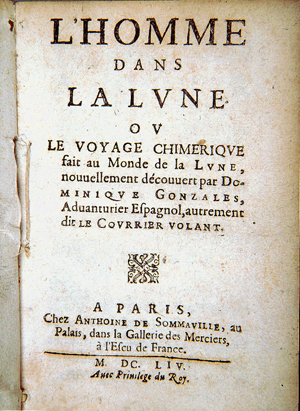
[Godwin, Francis, bp. of Hereford] 1562 - 1633

L'homme dans la lvne, ov Le voyage chimeriqve fait ou monde de la lvne, nouuellement découuert par Dominiqve Gonzales [pseud.], Aduanturier Espagnol, autrement dit le Covrrier volant.  A Paris, Chez Anthoine de Sommaville, 1654.

8 p. l., 176 p. illus. 16.5 cm.
1. Voyages, Imaginary. I. Title.
TLE1041.G59

Other copies and editions in the gimbel collection:  TLE1041.G59s 1708: . . . an account of the admirable voyage of Domingo Gonsales. . . to the world in the moon. . ., in [Nathaniel Crouch], The English acquisitions in Guinea & East-India. . . London, 1708; TLE1041.G59s 1768: The strange voyage and adventures of Domingo Gonsales to the world in the moon, . . . , 9th ed., London, 1768.

Godwin's The Man in the Moone was first published, anonymously, in 1638. The date of composition is uncertain but may have been ca. 1628. Immensely popular, it was frequently reprinted and translated into four languages. This abridged French translation by Jean Baudoin first appeared in 1648 and was reissued several times.

Despite its popularity (or perhaps because of it: popular books are quickly worn out), the first English edition is extremely rare. After a series of adventures, the hero, Domingo Gonsales, is put ashore on a distant island where he finds wild swans, a flock of which he tames. It occurs to him to use these to lift him from the earth. After a number of experiments, he eventually succeeds in being raised by twenty-five of them. After further adventures he uses his "gansas," as he calls them, to escape from danger but finds to his surprise that they take him in an unexpected direction: the birds hibernate on the moon. Before they arrive, he finds that he and the birds escape from the effects of the earth's gravity. Like a modern space rocket, the birds no longer need to use power but sail on through the air at great speed, moving their wings only rarely. Not only is physical gravity left behind, but Gonsales feels that he has escaped from all the spiritual heaviness of mortality. Once arrived at the moon, he describes it in great detail. The book had an enduring influence on subsequent writers of science fiction

Lana de Terzi, Francesco, 1631 - 1687

Prodromo; ouero, Saggio di alcune inuentioni nuoue premesso all'Arte maestra, opera che prepara il P. Francesco Lana Bresciano della Compagnia di Giesv. Per mostrare li piu reconditi principij della naturale filosofia, riconosciuti con accurata teorica nelle piu segnalate inuentioni, ed isperienze sin'hora ritrouate da gli scrittori di questa materia & altre nuoue dell' autore medesimo.  Dedicato alla Sacra Maesta Cesarea del imperatore Leopoldo I.  In Brescia, Per li Rizzardi, 1670.

4p. l., 252 p. 20 pl. (incl. music) 33 cm.
CONTENTS (in part). —Proemio, in cui l'autore dichiara qual sia per essere l'opera che'promette (Magisterium naturae, et artis. Brescia, 1684) p. 1-17. —cap.1. Nuoue inuentioni di scrivere in cifera. —cap.2. In qual modo un cieco nato possa imparare a scriuere [e] nascondere sotto cifera i suoi segreti. —cap.3. In qual modo si possa parlare senza mandar ne lettere, ne messagiere. —cap.4. Come si possa insegnare a parlare ad uno che per esser nato sordo sia muto—cap.6. Fabricare una naue, che camini sostentata sopra l'aria a remi, & à veli, p.52-61 and pl. [2] fig. III, IV, V.  At end of volume a French manuscript translation of this chapter (20 p.) preceded by a manuscript table of contents to the Prodromo in French. —cap.16. L'Arte maestra d'agricoltura. —cap.20. L'Arte maestra di chimica. —cap.21. L'Arte maestra di medicina. —cap.22. L'Arte maestra di aritmetica. L'Arte maestra sopra l'arte della pittura (4 chap.) L'Arte maestra: regole per fabricare molte sorti di cannocchiali, e microscopij (8 chap.)

Ex libris: Gaston Tissandier.  Vellum binding.  Spine title.  Plate sheets divided, tipped in, recto, at end. 1. Mechanical engineering—Early works to 1800.  2. Science—Early works to 1800.  3. Aeronautics.  4. Flying-machines.  5. Deaf and dumb—Means of communication.  6. Blind—Printing and writing systems.  7. Telescope.  8. Microscope and microscopy.  I. Lana de Terzi, Francesco, 1631-1687.  Magisterium naturae, et artis.  II. Title.       TJ144.L24
Brockett 7107; Gamble 1134

Other copies in the Gimbel collection: five complete copies.
1: Vellum binding. Spine title.  Each double sheet of plates bound between gatherings.  2: Vellum binding.  Spine title.  Plates sewn  and bound at end.  Bookseller's advertisement.  3: Vellum binding.  Spine title.  Bookplate of Mr. Howard A. Scholle.  Library card of Williams College.  4: Vellum binding.  Spine title, with cataloguer's label.  Plate sheets divided, tipped in, recto, at end.  Bookseller's typed note.  5: Modern binding.  Plates loose, sewn as gathering.  Bookplate of Theodore von Karman Memorial Collection.  Bookseller's typed note.


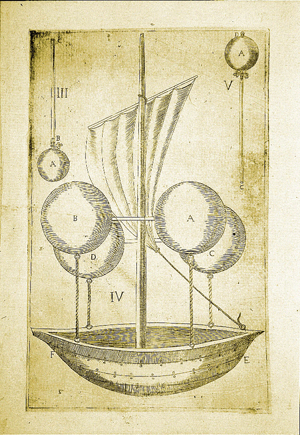
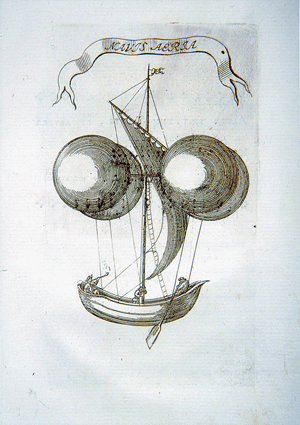
The Prodromo of the Jesuit priest Francesco Lana de Terzi is among the most frequently cited early books of aviation. Although his proposal for an airship began as little more than a scientific jeu d'esprit, it rapidly became very famous and was often taken seriously. It was frequently copied, embellished, and plagiarized. Lana surmised that large globes emptied of air would rise. He proposed that, on the basis of his calculations, the four globes, of thin copper or bronze (about 0.1 mm in thickness), should be twenty feet in diameter. He was aware of the experiments with the "Magdeburg spheres" (1654) that had so dramatically demonstrated the strength of air pressure (see Appendix, Guericke, Experimenta nova, 1672) and hoped—in vain, of course—that a purely spherical form would prevent the globes from collapsing. In a later treatise he suggested that the globes could be made of very light wood, such as is used for musical instruments. (Lana deTerzi, Magisterivm natvrae, et artis II, Brixiæ, 1686, pp. 293-294. See Appendix.) Such a structure should be strengthened with thin wooden laths bonded to it, and the whole might need to be varnished to keep it airtight. His calculations showed that globes so made need be only ten feet in diameter.

In the last paragraph of his description in the Prodromo, Lana commented that the greatest difficulty confronting anyone who might try to build such a machine would be insurmountable: God would not permit men to have at their disposal something so readily capable of destroying the fabric of society by immoral and violent means. He concluded by describing explicitly what he meant. His aerial ship could be used as a new weapon of war. It could carry soldiers to attack cities, private dwellings, and vessels at sea; iron weights, bombs, and fireballs could be dropped on ships and their crews; houses, fortresses, and cities could be destroyed with impunity since the aerial ship could operate from beyond the reach of defensive fire. This reads in part as a serious warning and in part as conventional self-protective rhetoric—withdrawal from personal involvement in a dangerous proposal.

Lana's proposal is akin to a much older idea. That a ship filled only with the "ether" that used to be thought to lie above the atmosphere could float on the surface of air, just as an air-filled ship floats on water, was the basis of a thought experiment by Nicole Oresme as early as 1377. Repeated several times by later writers, the idea was mentioned in 1640 by Bishop Wilkins.


Cyrano de Bergerac, Savinien, 1619 – 1655

Les oeuvres diverses de Monsieur de Cyrano Bergerac.  A Amsterdam, Chez Daniel Pain. 1699.

2 v. 16 cm.
With front. (port.) in each volume; and other illus.
PG1793.A1   1699
[Brockett 3234]; [Gamble 48]

Other copies and editions in the Gimbel collection:  PQ1793.A1 1709:  Les oeuvres de Monsieur de Cyrano Bergerac, illus., Amsterdam, 1709; PQ1793.A1 1710: another ed of the previous item, Amsterdam, 1710; PQ1793.A2A 1899: A voyage to the moon, an edition by C.H. Page of Lovell's translation, New York, 1899; PQ1793.A2A 1899: another copy of the previous item; PQ1793.A2K:  L'autre monde. . . preface by Steffi Kiesler, Paris, [194-]; PQ1793.A2Sc: Mondstaaten und Sonnenreich, trans. Martha Schimper, Leipzig, 1913; PQ1793.A2Al:  Voyages to the Moon and the Sun, trans. Richard Aldington, London [n.d.]


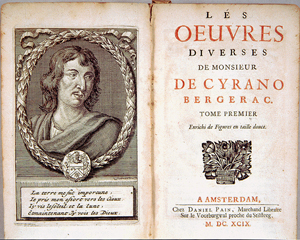
Following its first publication in 1650, new editions of Histoire comique des estats et empires de la lune (included in vol. 1 of this collection) continued to appear throughout the century. This high-spirited work of the imagination is a series of outrageous scientific spoofs. Cyrano's fictionalized alter ego made several attempts to fly to the moon. For the first he attached phials of dew to his body so that when the dew began to rise because of the sun's warmth he would be carried with it. By this means he flew high but mismanaged the balance of gravity and upward force and failed to reach the moon. A second attempt with an ornithopter also failed. He had better success, though inadvertently, when soldiers attached rockets to the wreck of his machine, which carried him up with it. The machine fell away beneath him and as he approached the moon he turned over, the lesser gravity of the moon having replaced that of the earth. He crash-landed on his feet. Another flight followed, this time a return journey made by the magical power of his attendant spirit.

His next and most imaginative journey was undertaken with an ingenious and still more incredible machine. Cyrano traveled past all the planets using a large, frail box with holes drilled in the top and bottom. Over the upper hole he placed a crystal vessel in the shape of an icosahedron, also with holes drilled in it, the one at its bottom coinciding with the upper hole in the box. The sun's rays filled the space in the crystal vessel, heating the air, which was driven out through its top hole. A "great abundance of Air" then rushed up through the hole in the bottom of the box and the energy of the air's movement carried the whole thing aloft. Once again Cyrano eventually lost his machine, which fell unharmed to Poland while he continued to the surface of the sun. Although, naturally enough, no one believed a word of this, Cyrano's sparkling imagination encouraged inventors to develop yet further ideas for motive force.


Happel, Eberhard Werner, 1647 - 1690

...Grösseste Denkwürdigkeiten der Welt, oder so genandte Relationes curiosœ...  Hamburg, Thomas von VViering, 1689.

600 p. illus. 20 cm.
At head of title: E.G. Happelii. Vierter Theil.
     [Issued in 5 v., 1683-1690.  Cf.BL 446.b.3-6.]
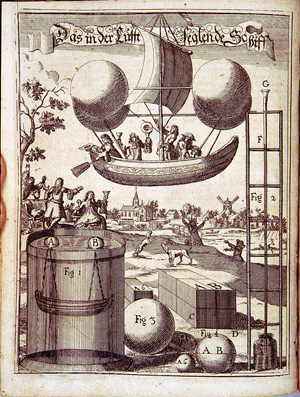
     Partial contents:  Das in der Luft seeglende
     Schiff, p. 308. Plate (Lana).
1. Geography.  2. History, Universal.  3. Natural history.  I. Title.
G114.H25

This book of natural "wonders"—an early encyclopedia—is one of many to copy Lana's design, with imaginative improvements. One of the crew steers the airborne ship by means of a rudder, which evidently needs little effort to manipulate. As in Lana's original, and in innumerable designs for steerable balloons and airships well on into the nineteenth century, the sail is falsely shown filled out by the wind and carrying the ship along. An awareness of the truth about relative speeds in the air was slow to develop. The earthbound onlookers, including the dogs, are astonished. The detail of the upward leaping dog is borrowed from representations of the shepherd-boy Ganymede, carried aloft by Jupiter, of which one of the best known is by Correggio (ca. 1530) in the Kunsthistorische Museum, Vienna. The skills of the modern scientist and engineer are shown to have surpassed the forces of pagan divinity.


Hooke, Robert, 1635 – 1703

Philosophical collections, containing an account of such physical, anatomical, chymical, mechanical, astronomical. . . experiments and observations as have lately come to the publishers hands... 
[London, Printed for John Martyn, 1679-1682].

>210 p. illus. 23 cm.
Issued in 7 numbers; continuous paging; imprint varies.
1. Science—Early works to 1800. I. Title.
Q155.H78


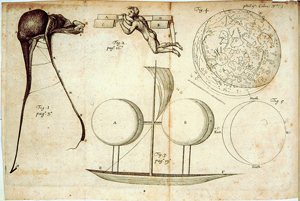
Hooke, the irascible secretary of the Royal Society, showed a lifelong interest in flight.  In the first issue of Philosophical Collections he reports on the abortive trials of a Mr. Gascoyn, carried out sometime around 1640 but about which nothing is known. Hoping to succeed where Gascoyn had failed, Hooke sketched many ideas for equipment to supplement human muscle power and once designed a helicopter, the details of which have not survived. 

He is also credited with having invented a model bird powered by "springs and wings," which "rais'd and sustain'd it self in the Air." Although like many other inventors in the period he looked first to birds for his ideas, he was unusual in also considering the wings of bats and even those of flying fish. Along with a sketch of Lana's airship, the illustration includes a design for a flying machine that had been published in Amsterdam only a few months before and was the nominal subject of Hooke's note. It shows Besnier, a locksmith of Sablé, flying with hinged wings made of taffeta stretched over frames and flapped by both arm and leg power. Besnier did not claim to have been able to rise from the earth, but he did allege that, starting from a height, he could sustain himself in a glide for long enough to be able to cross a river. The illustration, representing Besnier in classically nude style, is highly schematic. If he were indeed able to remain airborne at all, his equipment must have been very different from that shown. The wings must have been much larger and would not, of course, have flapped alternately as is sometimes shown in other illustrations (see, for example, Cambridge, The Scribleriad, 1751).


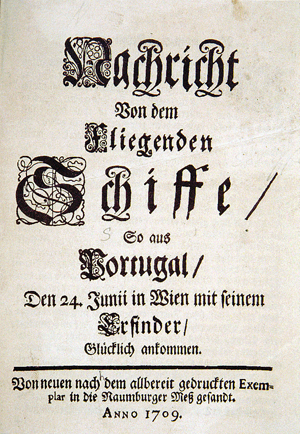
Nachricht von dem fliegenden Schiffe / so aus Portugal / den 24. Junii in Wien mit seinem Erfinder / glüklich ankommen...[n.p.,]1709.

[4] p. 27 cm.
English tr. (ts.) laid in.
1. Gusmão, Bartholomeu Lourenço de, 1685-1724.
TLB154.N2  1709


In 1709, the Brazilian Bartholomeu Gusmão managed to persuade the king of Portugal to grant him a patent for a flying machine that would be capable of covering distances of more than 200 miles a day. He called the machine a Passarola (great bird). Drawings of the Passarola, with a bird-shaped fuselage, feathered wings, and a sail-like canopy over the top, circulated rapidly and were frequently reproduced. There is some evidence that Gusmão had successfully built small hot-air balloons, and it is possible that he also demonstrated some form of glider. Many people were persuaded that he had achieved complete success with a man-carrying machine. This account, based on an imaginary news report from Vienna, tells of Gusmão's demonstration of manned flight before an awe-struck audience of the inhabitants. Gusmão is said to have started from Lisbon at 6 a.m. the day before and to have passed by the moon on the way.  Before he reached the city, some of the citizens, not knowing what was going on, thought that perhaps the Day of Judgment was beginning. The Passarola arrived, preceded and surrounded by a great flock of birds, like a celestial chariot encircled by angels. The landing, however, was less than divine: a sudden gust caused the canopy to be snagged on the spire of Saint Stephen's Cathedral, in the center of the city, where Gusmão hung for a couple of hours. As no one was willing to help, he had to free himself before landing a short distance away near the Hofburg. He related how, during the journey, he had frequently to fight off the attentions of strange celestial birds.


Martello, Pierjacopo. 1665 – 1727

Versi, e prose, di Pierjacopo Martello.  In Roma, Per Francesco Gonzaga, 1710.

16 p. l., 324 p. front., pl. 20.5 cm.
 Title vignette. Initials.

CONTENTS—Degli occhi di Gesù, libri sei, ad Amarilli—Del volo.—Della poetica, sermoni.

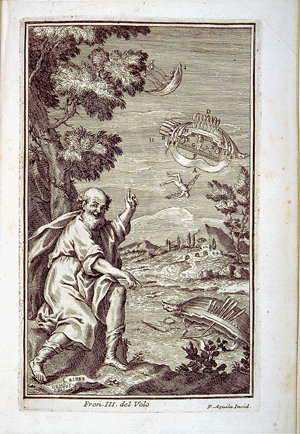
At the end of book IV of Degli occhi di Gesù  (first published Bologna, 1707) Martello describes an airship and its imaginary voyage.  When this edition of the poem was published, he added the four prose dialogues entitled "Del volo"; in later editions the fourth dialogue ("Mattina ultima") was suppressed.  Cf. Boffito, G., Biblioteca aeronautica italiana, 1929, p. 276; Venturini, G., Da Icaro a Montgolfier, 1928, I.272-298.
1. Jesus Christ—Poetry.  2. Airships.  3. Aeronautics.
TLB154.M37   1710
[Brockett 8072]

Other copies and editions in the Gimbel collection:  TLB154.M37  1729: 2nd ed., expanded, Bologna, 1729.


Poets as well as satirists frequently focused on the growing interest in manned flight.  Martello's long poem Degli occhi di Gesù describes a journey to the earthly paradise, guided by the great aeronautical charioteer of the Bible, Elijah (2 Kings 2:11). The prophet's flying machine is, however, supplanted by a new one based on a simplified version of Gusmão's Passarola.  Martello's ship, vastly bigger than Gusmão's, has landing gear: a set of grapples to hold the earth. He is also more explicit than Gusmão about the method of propulsion—so explicit, indeed, as to show that he treats the whole thing as an amusing fiction. The wings are attached to oars manipulated by a hundred galley slaves, all of whom are apes. Evidently aware of the real needs of eighteenth-century galleys, Martello describes two shifts of rowers who relieve each other by turns. He evidently has no faith in the common idea that flight in the regions above the lower atmosphere was effortless.

In the third part of the tract Del volo, attached to Degli occhi di Gesù, Martello discusses flight in general and comments on the flying machine that he described in the poem and which he assures the reader was only a poetic invention. He discusses problems of stability, pointing out that any lack of coordination among so many rowers would have worse consequences than in a ship on water and would lead to the machine's crashing to the earth. He therefore suggests a mechanism for keeping the oars synchronized. Martello gives a full description of the Passarola, this time much closer to Gusmão's, shown coming to grief in the second illustration along with a version of Lana's flying ship.


[Bordelon, Laurent] 1653 - 1730

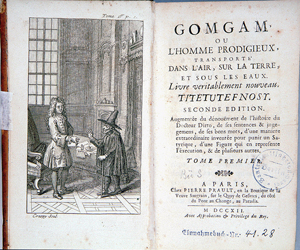
Gomgam, ou l'homme prodigieux, transporté dans l'air, sur la terre, et sous les eaux.  Livre veritablement nouveau.  Titetutefnosy.  Seconde édition.  A Paris, Chez Pierre Prault, 1712.

2 v. illus. 16.5 cm.
Tissandier, p. 7.
1. Voyages, Imaginary. I. Title.
PQ1957.B67A64   1712
[Brockett 2039]

Other copies and editions in the Gimbel collection: PQ1957.B67A64  1713:  new ed., Paris, 1713.


First published in 1711, this fantasy is a loose adaptation of the tale of Abaris, a legendary Scythian servant of Apollo who, in some Greek accounts, is said to have flown around the world on a golden arrow (see, for example, Origen, Contra Celsum, III.31). If there is any truth behind the story, it is probable that Abaris merely carried with him the golden arrow that is a symbol of Apollo's authority. The flying legend is explicitly mentioned toward the end of Bordelon's first volume, where it is said to be nothing but a fable; by contrast, the aerial power of Gomgam's golden arrow, which he acquires about halfway throughout the story, is alleged to be a reality. Despite a few passing comments about the nature of the physical universe, the frivolous tone of the book is in sharp contrast with aeronautical fiction of the previous century based on the imaginative development of scientific theories. One of Gomgam's journeys does nevertheless take him to examine and theorize about a rainbow.


Brunt, Samuel [pseud.]

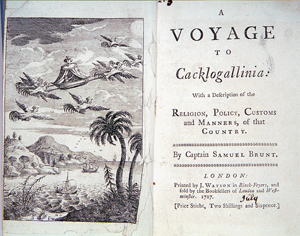
A voyage to Cacklogallinia: with a description of the religion, policy, customs and manners, of that country.  By Captain Samuel Brunt. London, J. Watson, 1727.

167 p. front. 18 cm.
"A journey to the moon," pp. 122-167.
1.  Voyages, Imaginary.  I. Title.
PR3328.B38   1727

Other copies and editions in the Gimbel collection: PR3328.B38  1751: Captain Samuel Brunts Reise...aus dem Englischen übersetzt, Leipzig, 1751.


A lively Robinsonade, this satire on contemporary mercantilism is indebted in many respects to the last book of Swift's Gulliver's Travels, which had appeared the previous year. “Captain Brunt” (who remains unidentified) finds a country inhabited not by talking horses but by talking birds, whose language he learns. His description of their society bears directly on that of England. The birds conceive a project of traveling to the moon to discover gold in its mountains. Brunt demurs, using arguments from previous writers, including, in particular, those of Wilkins (see Wilkins, A discourse, 1640), which focused on the difficulty of getting to the moon. He loses the argument and reluctantly agrees to head the expedition. In this, Brunt's story differs from many of its predecessors, whose heroes are only too keen to get to the moon. Brunt flies, but only in the sense that the birds bear him along with them in a specially constructed aerial carriage. The journey having been made, the moon is found to be an idyllic place where “chrystal Rivulets” seemed “so many Mirrors reflecting the various Beauties of those odoriferous flowers which adorn'd their Banks” (p.135). Contact is established with the idealistic moon-dwellers, who are of “neither a corporeal nor an aerial Substance, but... between both” (p.142). Brunt also finds that the moon is a place of dreams, partly inhabited by the souls of sleeping humans acting out their fantasies. These passages return the reader to some of the earliest myths about the relationship of moon and earth. Thereafter the satire continues for a time until Brunt is flown back—to Jamaica. In telling his story, Brunt quotes many scientific facts and theories, some taken directly from Godwin, Wilkins, and Cyrano; others are more up to date.


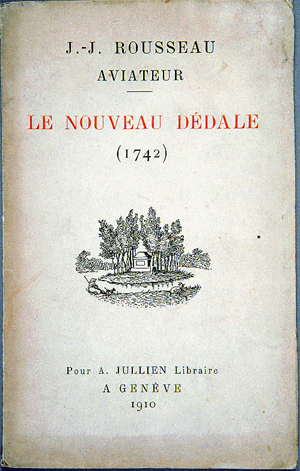
Rousseau, Jean-Jacques, 1712 - 1778

Le nouveau Dédale (1742).  A Genève, A. Jullien, 1910.

25 p., 1 1. 23 cm.
At head of title: J.-J. Rousseau, aviateur.

With reproduction of original t.-p.: Le nouveau Dédale; ouvrage inédit de J.-J. Rousseau, et copié sur son manuscrit original daté de l'année 1742.  A Paris, Chez Mme. Masson, [1801].
Introduction signed: Pierre-Paul Plan.
"Extrait du Mercure de France 16-x-1910 et tiré à cent soixante-quinze exemplaires."
With this is bound a copy of the original edition:  A Paris, Chez Mme. Masson...[1801].

1. Aeronautics.  I. Plan, Pierre-Paul, ed. II. Title.
TLB154.R86  1742
Gamble 100

Other copies and editions in the Gimbel collection: TLB154.R86a  1742: facsimile of 1st ed. (1801), Pasadena, [1950].


In 1742 a highly eccentric Frenchman called Jean-François Boyvin de Bonnetot, who falsely styled himself Marquis de Bacqueville, announced hat he would fly across the Seine from his house on the quai des Théatins (now the quai Voltaire) and land in the Tuileries. At that date he was about 60 years old. A crowd gathered to watch as Bacqueville, with wings attached to his arms and legs, threw himself from a window. Exaggerated accounts say that he flew for "100 fathoms" (600 feet) before falling into a laundry boat where, as is so often related in accounts of such attempts, he broke his thigh. He nevertheless survived his ordeal and did not die until 1760—and then only in a fire that burned down his house. Rousseau, who had been among the crowd of onlookers at the attempt to cross the Seine, was prompted by the event to write a speculative essay on the possibility of human flight, which he found an intriguing puzzle. (He plays on the meaning of dédale as a common noun: maze, or labyrinth.) Taking up the idea of aerial navigation, he points out that a flying machine will not sail on the surface of the air, as does a ship on water, but will be immersed in it. He focuses also on the difficulty of maintaining control over the altitude of any machine dependent on lighter-than-air principles.


[Cambridge, Richard Owen] 1717 - 1802

The Scribleriad: an heroic poem.  In six books...  London, Printed for R. Dodsley . . . and sold by M. Cooper. . ., 1751.

6 pt. in 1 v. front., 6 pl. 26 cm.
Title vignette.
Each part has separate t.-p. and paging.
Preface signed.
I. Title.
PR3339.C125
[Gamble 45]

Other copies and editions in the Gimbel collection: PR3339.C125L: An aerial race between a Briton and a German... [extracts, illus.], London, 1918.

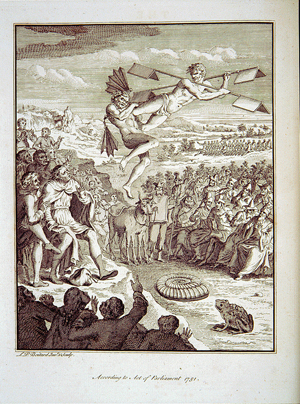
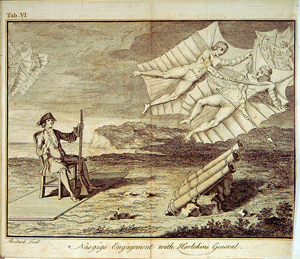
Cambridge's Scribleriad is written in imitation of Pope's Dunciad. Among its several mock epic events is a race between a German and a Briton, both equipped with artificial wings. The illustration (frequently reproduced) shows the German using modern technology—the flapping wings of Besnier, but without the harness that enabled Besnier to use leg power. Although, like Besnier, the German is essentially naked, he wears a loincloth suitable for a public ceremonial occasion before an elegantly dressed audience. He is a fine, athletic, young man. 

His opponent is fully naked and more rugged, to suggest more primitive origins. The Briton's wings, damaged because, like Icarus, he has flown too high, do not depend, as do those of the German, on up-to-date technology but resemble those described in very early accounts of manned flight. Cambridge makes the comparison explicit: the Briton falls because of his excessive ambition. Having flown too high, he finds that the air will no longer support his weight. He plunges to the earth, catching the German's foot and treacherously carrying him down as he passes. To describe the Briton's fall, Cambridge translates Ovid:

     His naked arms in yielding air he shook:
     His naked arms no more support his weight,
     But fail him sinking from his airy height.
     (IV.148-149)

As compensation for his ill fortune, the German is ironically rewarded with a statue of Icarus.


[Paltock, Robert] 1697 - 1767

The life and adventures of Peter Wilkins, a Cornish man. . . Taken from his own mouth, in his passage to England, from off Cape Horn in America, in the ship Hector . . .

Illustrated with several cuts . . . presenting the . . . wings of the Glums and Gawrys . . . By R.S., a passenger in the Hector...  London, Printed for J. Robinson and R. Dodsley, 1751.

2 v. illus. 17 cm.
First ed.
I. Title. II. Title: Peter Wilkins.
PR3615.P5p   1751
[Gamble 93]

Other copies and editions in the Gimbel collection: PR3615.P5p   1783: another ed., London, 1783;  PR3615.P5p   1783a: another copy of the previous item; PR3615.P5p   1784: another ed., Berwick, 1784, Gamble 93;  PR3615.P5p   1828: first American ed., Boston, 1828, R-P 13;  PR3615.P5p   1828a: "improved" ed. (i.e., bowdlerized and abridged), Boston, 1828;  PR3615.P5p   1830: reprint of the previous item, Boston, 1830;  PR3615.P5p   1832: another abridged ed., Boston, 1832;  PR3615.P5p   1833: abridgement of 1828 with col. ill., Boston, 1833;  PR3615.P5p   1839: reprint of an ed. originally prepared for children by Robert Dodsley, London, 1839;  PR3615.P5p   1840: reprint of the abridged ed. of 1828, Boston, 1835 [i.e., 1840];  PR3615.P5p   1843: another abridged ed., Hartford, 1843;  PR3615.P5p   1847: abridged ed., Boston, 1847;  PR3615.P5p   1848: abridged ed., Philadelphia 1848;  PR3615.P5p   1854: abridged ed., Philadelphia, 1854;  PR3615.P5p   1856: dramatized version in two acts, 22 p., 2 copies, New York, 1856?, R-P 34;  PR3615.P5p   1884: reprint, with t.-p. of 1st ed., London, 1884; PR3615.P5p   1915: modern ed. (Everyman), London and New York, 1915;  PR3615.P5L5  1925: modern ed.,  London, 1925;  PR3615.P5pa: abridgement (39, [1] p.) and satire, London, [1802];  PR3615.P5pf: Les hommes volants. . ., French trans., illus., Paris, 1763, Brockett 12901.


Beginning as another Robinsonade, Paltock's book also adapts material from Swift's Gulliver's Travels. Remaining extremely popular throughout the eighteenth and nineteenth centuries, it was translated into several languages. Peter Wilkins finds himself in a strange subterranean world inhabited by Glums and Gawries—male and female creatures who are almost exactly like human beings except that they can fly by the use of a ribbed membrane, which grows with them as they mature and which they can detach when they desire. In vol. 1, chap. 20, Paltock gives a description of the wings and their structure so detailed as to suggest that he might have envisaged someone's trying to make a pair. Peter Wilkins lives among these people for many years and marries one of the Gawries, producing seven children. The popularity of Paltock's book owes much to the deep-seated wish, felt by many people, to fly by natural means rather than by the use of a machine. The book helped to encourage experiments with ornithopters.


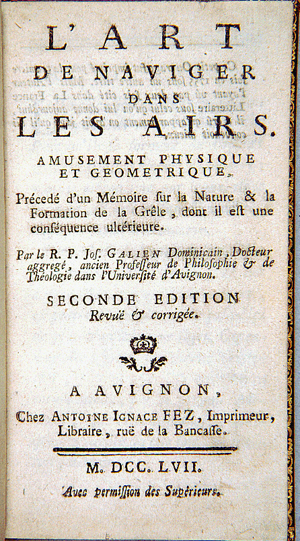
Galien, Joseph, 1699? - 1762

L'art de naviger dans les airs.  Amusement physique et geometrique, précedé d'un Mémoire sur la nature & la formation de la grêle, dont il est une consequence ultérieure.  Par le R.P. Jos. Galien... 2. éd., rev. & cor.   A. Avignon, Chez Antoine Ignace Fez, 1757.

2 p. l., 87, [1]p. 14.5 cm.
First edition published anonymously, 1755, under title:  Mémoire touchant la nature et la formation de la grêle et des autres météores qui y ont rapport, avec une conséquence ultérieure de la possilibité de naviger dans l'air à la hauteur de la région de la grêle.
Bookplate of Albert Tissandier.
1. Aeronautics.  2. Hail.  I. Title.
TLB397.G15

Although suggestions for airships or balloons filled with "ether," or air of superfine nature found at high altitude, were made as early as the Middle Ages, Father Galien's proposed airship is probably the most grandiose ever imagined. As a spin-off from a serious discussion of the formation of hail—a recurrent problem for agriculture in the south of France—Galien describes his idea for a flying machine filled with light air, the volume of which would be the equivalent of a cube on a side of 6,000 feet. Longer and wider than the city of Avignon, the ship would be capable of carrying 4 million people, plus their baggage, together with a cargo of 58 million hundred-weight. He speculates that such a ship, an order of magnitude larger than the Ark, could provide refuge from another flood or perhaps from a new danger: a world engulfed in pestilential air. The crew would manage the ship from little skiffs suspended from the sides with ropes and pulleys. Although based on sober calculations, Galien's airship is little more than a semiscientific amusement. In concept it is not, however, even semitechnological. Galien gives no thought to the engineering problems that would confront anyone trying to build such a structure from the materials he suggests:  skins, cables, cords, and strong double cloth waxed or treated with pitch. He says nothing at all about the means of propulsion, and he does not suggest how his ship might be used to alleviate the thunderstorms with which he began.


Morghen, Filippo, b. 1730?

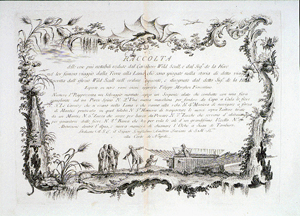
Raccolta delle cose più notabili vedute dal cavaliere Wild Scull, e dal Sig. r de la Hire nel lor famoso viaggio dalla terra alla luna che sono spiegate nella storia di detto viaggio descritta dall'istesso Wild Scull nell'ordine seguente, e disegnate dal detto Sig.r de la Hire.  Esposte in nove rami incisi appresso Filippo Morghen Fiorentino.  Numero 1o.  Rappresenta un selvaggio montato sopra un serpente alato che combatte con una fiera somigliante ad un porco spino.  N. 2o. Vna nuonva macchina per fendere da capo a coda le fiere.  N. 3o. Le carozze che si vsano nella luna e che vanno alla vela.  N. 4o. Maniera di navigare a forza di mantici praticata in quel globo.  N. 5o. Maniera di trasportare le merci sopra zattere tirate da un mantice.  N. 6o. Zucca che serve per barca da pescare.  N. 7o. Zucche che servono d'abitazioni per garantirsi dalle fiere.  N. 8o. Barca che ha per vela le ali d'un grandissimo vccello.  N. 9o. Abitazione dentro,l’aqua,  e nuova maniera di chiamare l'oche a suon di tamburo.  Dedicata a.s.e. il signor Guglielmo Amilton, inviato di S.M.B.ca alla corte di Napoli.  [Naples? ca. 1760]. 

1 p. l., 9 pl. 40 x 54 cm.
Engraved t.-p. showing the Cavalier Wild Scull and Signor de la Hire descending from their flying machine on the moon and introducing themselves to its inhabitants.
Plates in first state.

Another issue has title:  Raccolta delle cose più notabili vedute da Giov. Wilkins erudito vescovo inglese nel suo famoso viaggio dalla tera alla luna con i disegni di animali e machine a noi incognite e dal medesimo descritte nella sua celebre Istoria, esposte in nove rami incisi appresso Filippo Morghen Fiorentino.  N. 1o. Rappresenta un selvaggio montato sopra un serpente alato che combatte con una fiera somigliante ad un porco spino... N.9o. Abitazione dentro l'acqua, e nuova maniera di chiamar l'oche a suon di tamburo.  Dedicata a s.e. il signor Guglielmo Amilton, inviato di S.M.C.rca alla corte di Napoli. 1764.

The plates have no connection with the text of John Wilkins' Discovery of a world in the moone (London, 1638) to which the title apparently refers.
1. Voyages, Imaginary.  I. Wilkins, John, bp. of Chester, 1614-1672.  The Discovery of a world in the moone.
TLE1041.M86


The title announces that this is a collection of "the most noteworthy things seen by the Cavalier Wild Scull and Signor de la Hire during their famous voyage from the earth to the moon." A set of engravings without text, it is prompted in part by Bishop Wilkins.  While the name "Wild Scull" suggests an imaginary adventurer, "Signor de la Hire" refers to a well-known scientist, Phillippe de la Hire (1683-1768), who did not believe that the moon was habitable. As is indicated in the catalog entry, de la Hire's name was replaced in later editions by that of  the more imaginative Wilkins. The illustration on the title page shows the two adventurers shortly after their arrival on the moon, respectfully greeting the inhabitants. Their flying machine is like a low wooden house or shed equipped with a pair of wings. It may owe something of its conception to the legend of the transport of the Virgin's house to Loreto. There is no indication as to how the wings were operated. Other engravings in the set show details of life in a charming, zany, lunar world like something out of Lewis Carroll or, even, in some cases, Roald Dahl.


Paucton, Alexis Jean-Pierre, 1732 - 1798

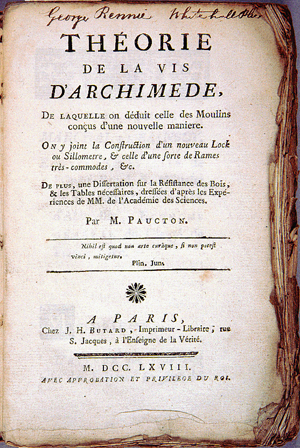
Théorie de la vis d'Archimede, de laquelle on déduit celle des moulins conçus d'une nouvelle maniere.  On y joint la construction d'un nouveau lock ou sillometre, & celle d'une sorte de rames très-commodes, & c. De plus, une dissertation sur la résistance des bois, & les tables nécessaires, dressées d'après les expériences de MM. de l'Académie des sciences.  Par M. Paucton. . .    A Paris, Chez J.H. Butard, 1768.

xx, 6 p. l., 214, [10] p. 7 fold. pl.18 cm.
1. Archimedean screw.
TLB397.P32

At the end of this dissertation on the properties and uses of the Archimedean screw, Paucton suggests its application to the building of a helicopter (pp. 210-214). Although he protects himself from ridicule by alleging that he is writing only for amusement, it is clear that he has an entirely serious, practical idea in mind. Following much calculation based on the primitive hydro- and aerodynamic theories of his day, he states that since a man can support his own weight on his arms, he should be able to lift himself into the air by turning rotor blades fitted to a suitable chair and operated by a handle, everything being built lightly and with care to minimize friction. As the movement is simple, friction would in any case be low. The rotor blades would be sectors of a full circle. For directional control a second, horizontal rotor should be added. When the aeronaut needed to rest, he could move a lever that would turn the blades of the upper rotor, reducing their pitch to zero and thus form a closed canopy. With this parachute above him, he would sink gently to the ground. Paucton's calculations indicated that the necessary total surface of the upper rotor blades would be 144 square feet. Paucton's book, which contains many detailed arithmetical tables but no drawings, was read by many later theorists of aviation. Illustrated variants of his design turn up frequently, some even in patents of the nineteenth century. A similar suggestion by Robert B. Taylor (1842) is discussed in Charles H. Gibbs-Smith, Sir George Cayley's Aeronautics, 1796-1855 (London: HMSO, 1962), pp. 102-108.


Zamagna, Bernardo, 1735 - 1820

Bernardi Zamagnae S.J. Navis aeria et Elegiarum monobiblos.   Excudebat Romae Paullus Giunchius, 1768

xvj, 151, [1] p. 1 illus. 18.5 cm.
Engraved title vignette: tail-pieces.
"Navis aeria," a poem written in honor of F. Lana de Terzi and his airship project, describes an imaginary trip by airship to various parts of the world.
"Idyllium I-IV" p. 131-151
1. Lana de Terzi, Francesco, 1631-1687.  2. Voyages, Imaginary.  3. Aeronautics—Poetry.  I. Title: Navis aeria.  II. Title: Elegiarum monobiblos.
TLE1041.Z2
[Gamble 35]

Thoroughly versed in classical literature, the Jesuit father Bernardo Zamagna celebrated the invention of his countryman and fellow priest Francesco Lana de Terzi by writing an epic poem in Latin hexameters describing an imaginary voyage around the world. In the second canto, he describes the takeoff and the airship's 24-hour circumnavigation of the globe. Although far from being a great circle, Zamagna's imaginary route is generally westward. Written in conscious imitation of Virgil, the verses are accomplished, if far from truly Virgilian in tone and movement. Just as Virgil—and Lucretius before him—enjoyed making poetry out of technicalities, Zamagna writes at length about the structure of the flying ship and about the scientific theories that lay behind it. He is largely successful in his project of combining modern science and technology with the classical arts and in bringing the ancient epic journey not only into the modern world but into what, for him, was the future.


Daniel, John, of Royston [pseud.]

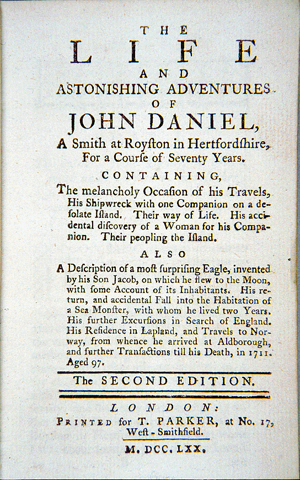
The life and astonishing adventures of John Daniel. . . containing the melancholy occasion of his travels. . . also a description of a most surprising eagle. . . on which he flew to the moon. . .   2nd ed. London: Printed for T. Parker, 1770.

319 p. illus. 17 cm.
Attributed to Ralph Morris
1. Morris, Ralph.  II. Title.
TLE1041.D17  1770

Other copies and editions in the Gimbel collection: TLE1041.D17: reprint of the 1751 ed., London, 1926, Gamble 88;  TLE1041.D17 1848: Flying and no failure! or, Aerial transit accomplished more than a century ago..., reprint of 1751 ed., Totham, 1848, Gamble 87.

First published in 1751, a rich year for aeronautical literature, this entirely fictional account of a journey to the moon acts as a vehicle for a serious (if impractical) suggestion for a real flying machine, which is illustrated and described in detail. The concept is entirely original for its period. The machine is a flapper of generally rectangular shape operated by the vigorous working of a handle like that of a water pump. Its frame is built mostly of iron "thin, light, and taper," and of "several pieces of wood." A set of carefully designed levers and hinges, carefully thought out, allows the ribs of the parasol-like structure to be simultaneously bent downward. After the downstroke on the handle is released, the ribs automatically bend back to the horizontal. The propulsive power thus comes from jet action like that of a jellyfish. Directional control is achieved by variations in the center of gravity, the flier standing on the appropriate side to cant the machine. The total lifting surface is on the order of 500 square feet. The idea for the flying machine was lampooned in 1769, immediately before this reprint, by an anonymous writer who, not having read the original, misunderstood the illustration. His version led many to believe that the machine stayed aloft because air was pumped from above to below.


Johnson, Samuel, 1709 - 1784

The Prince of Abissinia, a tale.   5th ed. London: Printed for W. Strahan, J. Dodsley, and E. Johnston, 1775.

viii, 304 p. 17cm.
I. Title.
PR3529.A1   1775

Other copies and editions in the Gimbel collection: PR3529.A1  1803: new ed., London, 1803;  PR3529.A1   1810: new ed., Frederick-Town [Md.], 1810;  PR3529.A1  1812: new ed., London, 1812;  PR3529.A1  1819; new ed., illus., London, 1819;  PR3529.A1  1826: new ed., Boston, 1826;  PR3529.A1 1829: new ed., Chiswick, 1829;  PR3529.A1  1831; new ed., Boston, 1831;  PR3529.A1  1844: new ed., Boston, 1844;  PR3529.A1   1850: new ed., Hartford [Conn.], 1850;  PR3529.A1  1864: new ed., New York, 1864;  PR3529.A1  1875: new ed., Philadelphia, 1875;  PR3529.F8  1832: the English text with a French translation, English and French on facing pages, Paris, 1832.


First published in 1759, this popular tale went through many editions. It is usually referred to as Rasselas, the name of the prince of the tale. The sixth chapter consists of a "Dissertation on the Art of Flying," a satirical discussion between the prince and a mechanic who believes he has invented wings for human beings. Rasselas takes a special interest because he wishes to escape from "Happy Valley," where life is idyllic but bland, to encounter a more bracing world. Wings will not, however, be of service to him. At the end of the chapter the mechanic "appeared furnished for flight on a little promontory: he waved his pinions a while to gather air, then leaped from his stand, and in an instant dropped into the lake. His wings, which were of no use in the air, sustained him in the water, and the prince drew him to land, half dead with terrour and vexation" (p. 43). Deeply pessimistic about all human endeavor, Johnson was probably responding to the many books about imaginary flight published a few years earlier; he may have read some of the many sarcastic accounts of the flight undertaken in Paris by the Marquis de Bacqueville. The idea that before takeoff a flier might need to "gather air" in the wings was frequently mentioned. By waving the feathers back and forth for a time, the flier would gather air in the interstices. Because air was thought to be naturally "light," this action would give the wings added buoyancy.


[La Follie, Louis Guillaume de]  1733? - 1780

Le philosophe sans prétention, ou L'homme rare.  Ouvrage physique, chymique, politique et moral, dédié aux savansPar M.D.L.F.   A Paris, Chez Clousier, 1775.

349, [1] p. front. 19.5 cm.
Engraved title vignette, frontispiece, and head-piece.  Incomplete: p. 337-338 wanting.
1. Physics—Early works to 1800.  2. Chemistry—Early works to 1800.  I. Title.
Q157.L16
Brockett 4686


This work, another that explores flight in unusual ways, belongs both to science fiction and to the class of imaginary voyages that brings an exotic traveler to us rather than sending a familiar hero to strange lands. The machine shown in the illustration is flown by an inhabitant of the planet Mercury. 

Written by a practicing chemist, the book explores the possibilities of flight by the use of static electricity. Having expected to see a flying chariot with wings, the narrator is surprised to find a strange and apparently unaerial piece of scientific machinery. Two glass globes each 3 feet in diameter are held on wooden members that are themselves covered with glass plates. Springs between the wooden members allow the globes to turn. The platform at the base is rubbed with camphor and covered with gold leaf. Metal wires surround the whole thing, which thus suggests some kind of primitive dynamo. The spinning globes produce a powerful beam of light shining in a downward direction. The light causes the machine to rise by reducing the air pressure above it, so that it can be made to travel in any direction at the pilot's discretion. The description of the mechanism and its effects, which occupies only a small part of the book near its beginning, is a piece of technobabble surpassing the propositions of the Projectors in Gulliver's Travels, Book III. La Follie's analysis of the relationship of air, fire, and static electricity, presented in a tone of total seriousness, reads like a forerunner of a speech from Dr. Who. The account of scientific discussions in the Mercurian academy is a thinly disguised parody of intellectual life in the French Academy and the Royal Society.


[Restif de la Bretonne, Nicole Edme] 1734 - 1806

La Découverte australe par un Homme-volant, ou Le Dédale français; Nouvelle très-philosophique: suivie de la Lettre d'un Singe, & c. . .   Imprimé à Leïpsick: Et se trouve à Paris, [1781].

4v. fronts. (v. 1, 2, 3) pl. (1 fold.) 16.5 cm.
Title vignette.
Half-title, prefixed to v.1: Oeuvres posthumes de N. ******. Oeuvre S. de, La découverte australe, ou Les Antipodes: avec une estampe à chaque Fait principal, 1781.
Paged continuously throughout the first, second, and part of the third volume (624 p.) where a new pagination begins, continuing through the fourth volume (422 p.)
Illustrated by Binet?  Cf. Cober, Guide de l'amateur de livres à gravures du XVIIIe siècle (1886), p. 503.
"Ouvrages du même auteur, dont on trouve des exemplaires à Paris, chés la veuve Duchêne..."; 2 p. at end.
Imperfect; plate to follow p. 357 (v. 2) and list of plates and contents (at end of v. 4) are wanting.
Book-plate (in v. 1): Ex libris Gaston Tissandier.
1. Voyages, Imaginary.  I. Binet, Louis, 1744-ca.1800, supposed illus.
II. Title.  III. Title: Homme volant.
PQ2025.D4
Brockett 10313

Other copies and editions in the Gimbel collection: PQ2025.D4 1818: Avventure e viaggi di un uomo volante.  Traduzione dal Francese, 2 v., Milano, 1818.


Restif's long novel brings together two themes often connected in the visual arts: flight and love. The hero longs to pay court to a girl whose social station is too far above his own to permit him to approach her. He decides to carry her off by force to a place inaccessible except by flight. For some years he studies the flying action of every winged creature, the details of which Restif explores in leisurely fashion. Like many aspiring birdmen before him, including Leonardo, the hero makes trials in secret. He feels dizzy during his first successful flight but rapidly accommodates to the experience. When he is satisfied with his equipment, he prepares a small settlement on a mountaintop, sowing seeds for a farm and carrying off the assistants he will need in order to lead a civilized life there: a group of astonished servants and a priest. The basket in the illustration is laden with some of his provisions. Finally he flies away with his beloved, who is content to be with him. There follows a long series of adventures, including scenes in the Antipodes of the half-title. The hero's flying machine consists of large wings made of oiled boxwood, leather, silken cords, and a small quantity of steel, operated by both arm and leg power. The parasol-like structure over the head can be rapidly opened and closed to provide lift and propulsion in a way similar to that described a generation earlier in the flying machine of Ralph Morris. As in the work attributed to Morris, a serious attempt to suggest a practical means of flight is given a fictional setting. The book was long popular, especially with female readers.


Faujas de Saint-Fond, Barthélemy, 1741 - 1819

Description des expériences de la machine aérostatique de MM. de Montgolfier, et de celles auxquelles cette découverte a donné lieu.  Suivie de recherches sur la hauteur à laquelle est parvenu le ballon du Champ-de-Mars. . .  A Paris, Chez Cuchet, 1783-1784.

2 v. illus. 20 cm.
Vol. 2 has title: Première suite de la Description des expériences aérostatiques.
1. Balloons, 2. Montgolfier, Joseph, 1740-1810.  3. Montgolfier, Étienne, 1745-1799
TLB273.F25
Brockett 4376, 4378; Gamble 563

Other copies and editions in the Gimbel collection: TLB273.F25 1784: 2nd ed., Paris, 1784, Brockett 4377;  TLB273.F25  1784a: another ed., Bruxelles, 1784;  TLB273.F25  1784d: Beschryving der proefneemingen..., Dutch trans. by Martinus Houttuyn, Amsterdam, 1784, Brockett 4375;  TLB273.F25  1784d2: Vervolg der proefneemigen..., [=continuation of the experiments..., preceded by Beschryving der proefneemingen...], Dutch trans. by Martinus Houttuyn, Amsterdam, 1784;  TLB273.F25  1784g:  Beschreibung der Versuche..., German trans., Leipzig, 1784-1785, Brockett 4374;  TLB273.F25  1784g2: Der Herren Stephan und Joseph Montgolfier Versuche..., 7 p., 8 pl., extract by C.G. von Murr, Nürnberg, 1784;  TLB273.F25  1784i: Descrizione delle esperienze..., Italian trans., Venezia, 1784.


A long period of preparation preceded the first manned flight in a free balloon, which took place on November 21, 1783. Among the many enthusiasts keen to assist the experimenters was Faujas de Saint-Fond, a geologist then in his early forties. An ebullient and energetic man, he organized a subscription on behalf of the inventor of the hydrogen balloon, Jaques Alexandre César Charles—although characteristically without first asking for Charles' agreement—and helped with the work that culminated in the first unmanned flight. He was equally enthusiastic about the subsequent successes of the Montgolfier brothers and wrote this very circumstantial account of the events throughout the period. Each of the flights is described in detail, with tables of weights, dimensions, and so on. The text is accompanied by excellent engravings showing the apparatus used both for hydrogen and for hot air balloons. The illustration here shows the balloon in which a sheep, a cock, and a duck were flown during the experiment with a montgolfière, 57 feet high and 41 feet in diameter, at Versailles in the presence of Louis XVI and his entourage, September 19, 1783. After the landing the animals were found to be in good shape, although half an hour before takeoff the sheep had kicked and damaged the cock's right wing, an accident that some reports falsely attributed to the rigors of the flight. Faujas complains about the sensational and inaccurate accounts that circulated after each experiment.


Charles, Jacques Alexandre César, 1746-1823

Représentation du globe aérostatique qui s'est élevé de dessus l'un des bassins du jardin royal des Thuilleries le 1er. décembre 1783, à 1. heure 40. min.tes. Avec le récit de son voyage aérien...  [Paris, 1783?].

xv p. 2 fold. col. pl. 26 x 20 cm.
Author's name appears in note on t.-p.: the ascension was undertaken by the author and M.N. Robert.
French and Spanish in parallel columns.  "Article du Journal de Paris de 13 & 14 décembre 1783."
1. Balloon ascensions.  2. Robert, M.N.  I. Title.
TLB276.C4R42

Other copies and editions in the Gimbel collection: TLB276.C4R42a: French and Italian in parallel columns, [Venezia, 1783].

Some three months after the first ascent of a hydrogen balloon, Charles and his assistants, A.J. and M.N. Robert (brothers who developed the gas-producing apparatus), announced a free manned flight to rival that of the montgolfière that had taken place on November 21, 1783. After some delay the flight was successfully made before a huge crowd on December 1, 1783. Charles, a scientist and the inventor of the hydrogen balloon, was accompanied by one of the Robert brothers. The strong netting  over the upper half of the balloon was intended to prevent its bursting as it rose into the thinner atmosphere. After a first landing, some 24 miles from Paris, Robert was left behind while Charles continued alone, rising to an altitude of 9,000 feet and making observations as he did so. The first balloon ascents coincided with, and were of course to a large extent the consequences of, the intense interest in science—and especially in chemistry—which characterized the final decades of the eighteenth century.


Pilâtre de Rozier, Jean-François, 1754-1785

Premiere expérience de la Montgolfiére construite par ordre du roi, lancée en présence de Leurs Majestés...par M. Pilatre de Rozier... le 23 juin 1774.  Imprimé aux frais du gouvernement... 

A Paris, De l’imprimerie de Monsieur, 1784.
20 p. 26 cm.
Head-piece.
Name originally: Jean-François Pilastre Desroziers.
1. Balloon ascensions.  I. Title.
TLB276.P6A34
Brockett 9754

Other copies and editions in the Gimbel collection: TLB276.P6A34 1784: 2nd ed., with date on t.-p. corrected, Paris, 1784.

A young man in his twenties, with some scientific experience, Pilâtre de Rozier was keen to be involved in the early balloon experiments and offered his services. Apart from the likelihood that Jacques-Étienne Montgolfier allowed himself to be raised some days before him, Pilâtre was the first to be lifted free of the earth in a tethered balloon. On November 2, 1783, he was accompanied by the Marquis d'Arlandes on the first demonstration of free flight. In this account of a flight in the following year, Pilâtre, who was accompanied by the chemist Joseph-Louis Proust (1754-1826), writes almost ecstatically, focusing especially on the peace experienced by those suspended beneath a free balloon: "it seemed, from the tranquillity with which we sailed, that we were carried along by the diurnal rotation of the earth." By his own account, they reached an altitude of 11,732 feet. Twenty-minutes after landing, the sense of peace was dissipated when strong winds pushed the balloon over, causing the brazier to damage it.

Pilâtre subsequently made many more flights before the first air crash on June 15, 1785, when he and a companion fell to their deaths from a height of about 1 mile in a burning balloon. Their vehicle on that occasion was inherently dangerous: a compound structure consisting of a montgolfière with a hydrogen balloon coupled above it.


Meerwein, Karl Friedrich, 1737-1810

L'art de voler à la manière des oiseaux, par Charles Frédéric Meerwein... A Basle, chez J.J. Thourneysen, fils, 1784.

48 p. 2 fold. pl. 18.5 cm.
First published in German.
"Lettre de m. de G*** à m. Meerwein": p. 36-44.
"Response à cette lettre, sous le nom de m. Merrwein [sic], par un ennemi juré des voleurs": p. 45-48.
1. Ornithopters.  I. Title.
TLD624.M49 1784
Brockett 8311

Other copies and editions in the Gimbel collection:  TLD624.M49 1784: a second copy, wanting t.-p.;  TLD624.M49 1785: 2nd French edition, Basle, 1785;  TLD624.M49 1785: a second copy.


Meerwein, who lived in a small town in western Germany, began experiments with ornithopters in 1781. He published his suggestion in a series of articles, in German, in January 1783. An expanded and improved version, which was widely read, was published as a book in 1784. This French translation, published in the same year, is a modified version of the German original with the addition of two facetious letters. A Portuguese translation appeared in 1812.

The span of Meerwein's ornithopter wing is 30 feet, and the maximum cord 10 feet. The mechanism is a simple up-and-down flapper operated by pushing down on the rod that the pilot is shown holding. The fully raised wings lie at an anhedral angle of about 9 degrees. Although the diagram does not show it, Meerwein specifies a fan-shaped tail: between the legs of a specially made pair of trousers reaching to below the feet is to be sewn a piece of cloth sufficiently wide to allow the legs to be spread. Meerwein envisages the use of this tail not for stability but as an aid to directional control—a common belief about the primary function of a bird's tail. There is no undercarriage, and the only provision for the pilot's safety and comfort is a face mask to enable him to breathe while speeding through the air. Together with the practical attempts at flight being made in France at the same time by Jean-Pierre François Blanchard (cf. Blanchard, An exact and authentic narrative, 1784) this exercise in primitive aeronautics helped to encourage other experiments, both serious and facetious.


Bourgeois, David

Recherches sur l'art de voler, depuis la plus haute antiquité jusqu'à ce jour; pour servir de supplément à la Description des expériences aérostatiques de M. Faujas de Saint-Fond. Par M. David Bourgeois... A Paris, Chez Cuchet, 1784.

viii, 143, [1] p. 20.5 cm.
1. Aeronautics—Hist.  2. Balloons.
TLB273.D44 no.1

Other copies and editions in the Gimbel collection: Two other identical copies, TLB398.B77;  TLB155.A247 no.1
Brockett 2071

One of the scores of books published in the year or two following the successful balloon flights of 1783, this work counts as one of the earliest extended attempts to write a history of aviation. Although Bourgeois' "researches" are anything but rigorous, he summarizes a substantial body of material about early flying stories, beginning with Abaris, continuing with other classical and mythological figures, including Daedalus and Archytas, and summarizing the theories of early scientists. In all, he discusses twenty-eight writers and experimenters, including Bacon, Albert of Saxony, Leonardo, della Porta, Cyrano, Kircher, Lana, Gusmão, and Galien. In the middle of the book, Bourgeois passes on to the principles of aerostation, the achievement of a practical balloon, and the problem of directional control. In his concluding pages he quotes passages from Lana and from Giovanni Alfonso Borelli, who, in his De motu animalium (2 v., 1680-1681, see Appendix), had demonstrated the impossibility of flying by the use of human muscle power alone.


Blanchard, Jean-Pierre, 1753-1809

An exact and authentic narrative of M. Blanchard's third aerial voyage, from Rouen in Normandy, on the 18th of July, 1784.  Accompanied by M. Boby; in which they traversed a space of forty-five miles in two hours and a quarter, inclusive of the time employed in raising and depressing the machine in the air.  To which are added four certificates, testifying the truth of the relation, and signed by several respectable characters.  Translated from the French of M. Blanchard... London, Printed by and for C. Heydinger, 1784.

2 p. l., [iii]-viii, 17 p. front. 28 x 22.5 cm.
TLB276.B6A15

1. Balloon ascensions.

Other related books in the Gimbel collection: The collection also holds accounts of his fourth voyage (English: TLB276.B6A25), fifteenth voyage (French: TLB276.B6A258), sixteenth voyage (French: TLB276.B6A26), forty-fifth voyage (English: TLB276.B6A29 1793, with two later copies: photocopy TLB276.B6A29; reprint TLB276.B6A29 1918), forty-fifth voyage (French: TLB276.B6A29f).  For the forty-fifth voyage, see Blanchard, Journal, 1793.

Brockett 1888; Gamble 468


Born on July 4, 1753, in Normandy, Blanchard (who became a skilled mechanic) was a man of relatively humble birth and an egotist of almost ruthless determination. In the early 1780s he made several attempts to build heavier-than-air machines, one of which had four wings, fore and aft, for lift, with another four, intended to provide forward propulsion, placed at the center. Despite failures, he persisted for some time before allying himself with the balloon experimenters. In 1784 he built a hydrogen balloon that, for safety, had a parachute placed under the bag on the top of the rigging and a pair of double-ended paddles worked by a treadle mechanism. Just before the launch, on March 2, 1784, an unfortunate quarrel led to Blanchard's being wounded in the hand; at the same time the balloon and some of its equipment were damaged. Blanchard nevertheless undertook the flight, reaching an altitude of something like 12,500 feet. In his account of his third flight, on July 18, 1784, he alleges that he was able to exercise some control over the balloon by the use of the paddles. In the years that followed, he made a precarious living from demonstrations of balloon flights, including one across the English Channel and others in the United States. In 1809 he died—remarkably enough, of natural causes—having made either 59 or 60 flights. His widow then took over, making 67 flights in all before falling to her death after having set fire to her balloon by indulging her showman's habit of setting off fireworks while aloft.


Lunardi, Vincent, 1759 – 1796

An account of the first aërial voyage in England, in a series of letters to his guardian, Chevalier Gherardo Compagni, written under the impressions of the various events that affected the undertaking, by Vincent Lunardi... London, Printed for the author, sold... by J. Bell [etc.], 1784.

2 p. l., 66, [1] p. front. (port.) fold. pl. 21.5 cm.
1.  Balloon ascensions.
TLB276.L8A16
Brockett 7816; Gamble 695

Other copies and editions in the Gimbel collection:  TLB276.L8A16  1784: 2nd ed., London, 1784.

An attaché of the Neapolitan embassy in London, Lunardi had the temperament of a showman. Determined to arrange the first real balloon ascent to take place in England, he constructed a hydrogen balloon, which he first exposed to view in the Strand to an estimated attendance of 20,000 visitors. On the afternoon of September 15, 1784, in the presence of George III, his Prime Minister William Pitt, the Younger, and a huge crowd, he flew from the Artillery Ground. (The best seats cost 5 shillings.) Written in the form of an epistolary novel, consisting of a series of letters to his guardian, his book provides a vivid account of the day-to-day difficulties he encountered in bringing his project to fruition. He had intended to fly in the company of another aeronaut, George Biggin, but the impatience of the crowd caused him to take off when the balloon had been sufficiently filled with gas to allow only one man to rise: "hesitation and delay, would have been construed into guilt" (p. 30). He did, however, take with him a pigeon (which escaped), a dog, and a cat. As is shown in the illustration, the balloon, 33 feet in diameter, was (pointlessly) equipped with a pair of oars one of which almost immediately broke and fell off, narrowly missing a spectator. Although the flight had no special technological significance, it contributed greatly to public sympathy for such exploits. In his account, Lunardi writes amusingly, if also with some edge, about the volatile reactions of the public and of the officials with whom he had to deal. Once success was evident, the flight was enthusiastically received and commemorated in a flood of verse, pamphlets, and decorated ceramic ware.


Cavallo, Tiberius, 1749 – 1809

The history and practice of aerostation.  By Tiberius Cavallo, F.R.S. London, Printed for the author and sold by C. Dilly [etc.], 1785.

viii, 326, [7] p. 2 fold. pl. 21.5 cm.
1. Aeronautics—Hist.
TLB273.C16
Brockett 2610; Gamble 499

Other copies and editions in the Gimbel collection:  TLB273.C16  1786: Histoire et pratique de l'aérostation..., French trans., Paris 1786.


An Anglo-Italian electrician and mathematician, Cavallo was born in Naples but came to England in 1771. He wrote several scientific treatises, mainly related to electricity and gas. A practical man, Cavallo experimented with the most suitable envelopes for balloons. He was among the first to make soap bubbles rise by filling them with hydrogen.Cavallo's history focuses almost exclusively on recent events. Of the twenty-three chapters in his book, all but the first part of Chapter 1 treat the history of ballooning during the two or three years following the experiments of Charles and the Montgolfiers. Although brief, his remarks on the thoughts and achievements of earlier centuries are in general well judged. He considers, but rejects the notion that the dove of Archytas might have been filled with "inflammable air" (hydrogen). If such a thing had been built, he says, it must have been so vast that it could hardly have passed into oblivion. In his summary of later commentators and experimenters, he makes his prejudices plain by dismissing the value of anything to do with heavier-than-air flight. The only earlier writer whom he respects, despite the impracticality of his proposal, is Lana.


[Blanchard, Jean-Pierre] 1753 – 1809

Journal of my forty-fifth ascension, being the first performed in America, on the ninth of January, 1793...  Philadelphia, Printed by Charles Cist, 1793.

27 p. front. 21 cm.
Dedicated to George Washington.  Signed: Blanchard.
1. Balloon ascensions.  1. Title.
TLB276.B6A29  1793
Brockett 1897; Gamble 470; R-P 5

Other copies and editions in the Gimbel collection:  TLB276.B6A29f: Journal de ma quarante-cinquieme ascension, la premiere faite en Amérique, le 9. janvier, 1793..., Philadelphie, de l'imprimerie de Charles Cist, 1793, 27 p. front. 20 cm. R-P 4.  This is the very rare Fench edition published by the same printer in the same year.  As Blanchard spoke no English, it is presumably the original text.  See also Blanchard, An exact and authentic narrative..., 1784.


Prompted mainly by a desire to find a new audience for his well-organized "balloon show," Blanchard decided, in December 1792, to try his luck in the United States, which, "so interesting by its situation, offered to my emulation an attraction which I could not resist." His first flight was an immediate popular success. On January 9, 1793, using a hydrogen balloon, he flew from the jail in Philadelphia—a choice of site dictated largely by practical considerations, though not without political implications. The ascent was watched by George Washington and a large number of other notable individuals. Blanchard reports that on the way he encountered and frightened a flock of birds and that when he had reached his maximum altitude (a little over a mile), a small black dog that a friend had entrusted to him as a companion showed signs of airsickness. He bottled samples of air and checked his own pulse rate (which had risen from an already high 84 to 92). He ate a little biscuit, drank a little wine, and prepared to descend. After the landing a frightened local assisted him—once Blanchard had persuaded him to try some of his wine—and was soon joined by others. By Blanchard's reckoning, this ascent was his forty-fifth, which he described in an almost euphoric manner. Although it made him famous in America, the flight was a financial disaster. He stayed on for another five years but with no greater success and in 1798 returned to France, saying that the visit had ruined him.


Robertson, Étienne Gaspard, 1763-1837

La Minerve, vaisseau aërien destiné aux découvertes, et proposé à toutes les académies de l'Europe; par le physicien Robertson... 2 éd., rev. et cor.  Vienne, De l'imprimerie de S. V. Degen, 1804; réimprimé à Paris, chez Hocquet, 1820.

iv, [5]-36 p.pl. (1 fold.) 20.5 cm.
"Ex libris Gaston Tissandier."
1. Balloons.  I. Title.
TLD932.R65
Brockett 1042; Gamble 781

Related holding in the Gimbel collection: TLB276.R64A24: Extrait du rapport fait à l'Académie des Sciences de Saint-Petersbourg, par M. Robertson, de son voyage aérostatique avec M. Sacharoff, [n.p., 1804].  Extract from Annales de Chimie, v. 52, [121]-142.

This remarkable design for a vast airship is a spin-off from the early interest in the potential value of balloons for scientific investigation. In 1803 the Saint Petersburg Academy of Science arranged to have a series of experiments made at altitude. These included gathering samples of air and measuring magnetic dip. The observations, of doubtful value were made in January 1804 by Robertson, accompanied by Sacharoff, a member of the Academy. The list of items taken on the flight provides an interesting insight into the methods used: chronometer, barometer, thermometer, pigeons, other birds, megaphone, telescopes, firearms, chemicals, quick-lime, gas-jars, money, water, wine, bread, cooked chicken, and other food. (For his first flight in England, Lunardi was also provided with wine, bread, and chicken.) Although styling himself a physicist, Robertson was not altogether dedicated to the sciences but enjoyed playing the role of part-time entertainer.

The Minerve is among the largest balloons ever conceived. A charlière (a hydrogen balloon named after its inventor, physicist J.A.C. Charles) with a diameter of 150 feet, it was designed to carry a load of 161,000 pounds including a company of 60 scientists. As the illustration makes clear, it is imagined as a true flying ship, complete with dinghy, or jolly-boat (in the form of a smaller balloon), an anchor, and ample accommodation for the travelers, study (on the gallery), and a gymnasium (under the prow). The main hull could be used as a conventional ship in the event of a mishap over water. (The proportions of the diagram are not, of course, always worked out.) As the ship is not normally immersed in water, other accommodation and provisions could be slung below. The suspended accommodation at the rear is intended for a small number of female observers, who would be kept apart from the men for fear of distracting them (perhaps a disguise for a brothel). Despite the pointless provision of a log at the rear, Robertson is aware that a technique for directing the horizontal movement of a balloon had not then been developed. The forward sail is intended only to show whether the balloon is rising or descending. The Minerve is neither designed for the benefit of an idyllic society nor intended, as were some earlier imaginary flying machines, to enable mankind to get away from it all. It is equipped with cannons and a strong military presence: outside the church and on the upper equatorial gallery, guards may be seen on duty, one of them standing by a gas-lamp standard—a recent invention.  

Named for the goddess of wisdom, the Minerve was intended to make possible scientific study of the whole globe as the vehicle drifted from place to place. Wherever it goes, says Robertson, there will be things of interest. The banner at the top bears the inscription Scientiarum favore: "By the grace of knowledge."

Already to some degree a scientific joke, Robertson's concept was several times parodied by later artists and commentators.



Dresdner Chronicken, und Geschichts, Calender 1809.  Dresden, Christian August Otto, [1809].

[56] p. illus. 21 x 17.5 cm.
Cover title.
Imperfect: back cover wanting.
Partial contents: Auch fliegen kann der Mensch... Jacob Degen, p. [29-32]. Illus.
1. Almanacs, German.  2. Degen, Jacob, 1750-1848.
AY854.D7

A Swiss, and by profession a clock-maker, Jacob Degen lived in Vienna.  Between about 1807 and 1817 he spent much of his time experimenting with flying machines, some of which he tested in public in Vienna's Prater Park. The most celebrated of his inventions, illustrated here, was misrepresented in press reports and in some drawings, winning for Degen an unjustified reputation as a charlatan. As shown, Degen hoped to be able to fly with a pair of flappers operated, like those of Meerwein, by a depressible rod. Unlike Meerwein's, Degen's wings were fully trussed and were made not of a single unbroken surface but of 3,500 flap valves cut from varnished paper. The valves closed on the downstroke and opened on the upstroke. When he tried the apparatus indoors, he was able to obtain some lift but could raise himself from the floor only when he partially counterbalanced himself and his machine with a pulley-and-weight system. Taking advice from a visiting journalist, Degen decided to replace the pulley and weight with a small balloon and to try the combination out of doors. With this apparatus he gave demonstrations not only in Vienna but also in Berlin and Paris. It was in Paris that a crowd, disappointed by the quality of his display, mobbed him and caused him serious injury. Reports of Degen's experiments, widely circulated, stimulated many other experimenters, including in particular one of the most important figures in early aviation history, Sir George Cayley. They also caught the attention of a less fortunate man, Albrecht Berblinger, the so-called tailor of Ulm who, in the presence of King Frederick of Württemberg, tried to fly across the Danube in 1811 using a copy of Degen's wings but without taking the precaution of making prior tests. He fell into the river from which he had to be fished out by passing sailors. A replica of the tailor's apparatus can be seen in the Rathaus at Ulm.
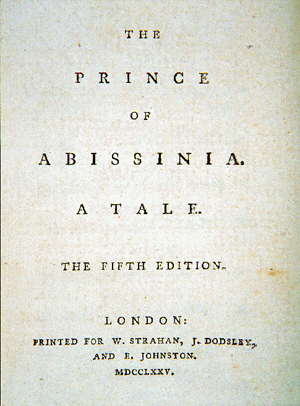
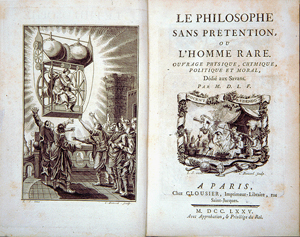

Walker, Thomas, portrait painter

A treatise upon the art of flying, by mechanical means, with a full explanation of the natural principles by which birds are enabled to fly; likewise instructions and plans for making a flying car with wings, in which a man may sit, and, by working a small lever, cause himself to ascend and soar through the air with the facility of a bird...  By Thomas Walker, portrait painter, Hull.  Printed by Joseph Simmons, and sold by Longman, Hurst, Rees, & Orme, London, 1810.

x, [5]-67 p. fold. col. front. 22.5 cm.
1. Flight.  2. Ornithopters.  I. Title: The art of flying.
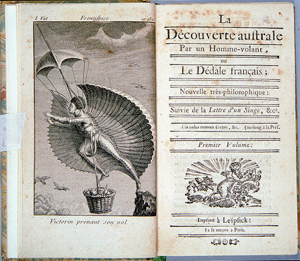
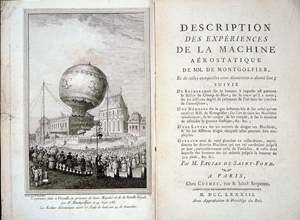
TLD209.W17
Brockett 12618; Gamble 2229; [R-P7,8]

Other copies and editions in the Gimbel collection:  TLD209.W17  1814: first American ed., New York, 1814, Brockett 12616 TLD209.W17 1910: reprint with facsimiles of t.-p.s of first ed. (1810) and of 2nd ed. (1831), [London], 1910.


The true mechanism of bird flight was not understood until recent times, and indeed some aspects of the matter are still undergoing investigation. Leonardo's ornithopters were fundamentally flawed in conception, as indeed were virtually all those proposed in later centuries, including Thomas Walker's. Although he does not make the old mistake of thinking that birds strike their wings down and back, his theory of flight, based on the elasticity of air, is wholly mistaken. (He drew false conclusions from the flight of the small paper glider drawn at top-left of the illustration.) His book, especially in the revised edition of 1831, was nevertheless influential. Using calculations based on published studies of the condor, Walker proposed a rather heavy structure in which the flier sits in something akin to the cockpit of a light airplane. He operates the wings by pushing the stick-like lever backward and forward through a very wearying total distance of 3 feet. Control of ascent, descent, and turns would come from shifting the pilot's center of gravity. After having observed birds landing, he suggested a quick nose-up pitch immediately before touchdown. In the revised edition published in 1831, Walker moved away from his focus on a bird-like configuration and proposed a tandem-wing structure foreshadowing that of Samuel Pierpont Langley's machines.


Fowler, George

A flight to the moon; or, The vision of Randalthus.  By Geo. Fowler.  Baltimore: Printed and sold by A. Miltenberger, no. 10. North Howard Street, 1813.
185 p. 18 cm.
1. Moon.  2. Voyages, Imaginary.  I. Title.
TLE1041.F78

An early American example of the moon-journey, Fowler's little-known book is indebted to Swift and to Cyrano de Bergerac, from whom he took, among other things, the idea that the hero would turn over halfway between the earth and the moon as gravity was reversed. He is also indebted to the many representations of Diana, Luna, or Selene, goddesses of the moon, who were often imagined as surrounded by a fine white haze or mist. Fowler's hero, Randalthus, is led to the moon by a beautiful woman enveloped in a milk-white cloud. She announces to him that he is "destined to visit the moon!"

She here vanished in a vivid flash of light, but I was greatly astonished when I found myself encompassed apparently in the very cloud in which she had appeared, and swiftly advancing above the confines of the earth. I hardly had time to look down and behold the gradual disappearance of the earth before every part of it seemed involved in confusion. (p.7)

In some respects the book's opening pages present a variant of the myth of Endymion, the beautiful young shepherd with whom the goddess of the moon fell in love. The imagery of those pages sometimes anticipates that of Keats' treatment of the theme in his long poem Endymion (1818). Writing the bulk of the book in the style of early pedagogic dialogue-treatises, Fowler has his hero instruct the Lunarians, and thereby the reader, in basic physical matters such as the nature of the tides and the reflection of earth-light by the moon. Following a familiar and well-established convention, he also uses the journey to exotic places as an excuse for offering moral and satirical comments about the state of society on earth.


[Locke, Richard Adams] 1800 - 1871

Great astronomical discoveries lately made by Sir John Herschel. . . at the Cape of Good Hope.  [n.p.,1835]

28 p. 25 cm.

First published in the New York Sun, from the Supplement to the Edinburgh Journal of Science.

A hoax.
1. Herschel, Sir John Frederick William, 1792-1871.
I. Title.
QB52.L81  1835g

Other copies and editions in the Gimbel collection: QB52.L81  1835: Grandes descubrimientos astronómicos hechos recientemente por Sir John Herschel..., trans. Francisco de Carriou [sic], Habana, 1835;  QB52.L81  1835d: Découvertes dans la lune..., traduit de l'Américain, Turin, 1836;  QB52.L81  1835f: Delle scoperte fatte nella luna dal Dottore Herschel, Firenze, 1836, Italian trans., with front.;  QB52.L81  1836: Grandes descubrimientos..., 2nd ed., Madrid, 1836;  QB52.L81  1836b: Découvertes dans la lune..., another ed., with ms. notes by A. Baron (1864, Lausanne, 1836;  QB52.L81  1836d: another ed. of the Italian version, Livorno, 1836: QB52.L81  1836e: another ed., with ms. notes by A. Baron (1864, Lausanne, 1836;  QB52.L81  1836d: another ed. of the Italian version, Livorno, 1836: QB52.L81  1836e: another ed. of the Italian version, [n.p., 1836];  QB52.L81  1836g: Neuste Berichte..., German trans., Hamburg, 1836;  QB52.L81  1836i: Intorno alle scoperte fatte nella luna, [perhaps = the first Italian edition], [Ravenna, 1836];  QB52.L81  1836p: Publication complète des nouvelles découvertes de Sir John Herschel..., another version of the French ed., Paris, 1836;  QB52.L81  1852: The celebrated "moon story," its origin and incidents,... by Wiliam N. Griggs [with the original articles], New York, 1852;  QB52.L81  1859: The moon hoax..., another reprint, New York, 1859;  QB52.L81  1975: a reprint of the previous item, Boston, 1975.


This entertaining spoof was first published in the New York Sun in 1835. It caught the public imagination, increased the paper's circulation fivefold (or so claimed the proprietors), and was quickly reissued as a pamphlet. In the following months it also appeared in French and Italian. The hoax alleged that the Herschel telescopes had been able to detect wonders on the moon's surface, including a numerous race of batmen. The illustration (which is from the frontispiece to the Italian translation, Firenze, 1836) shows a curious mixture of ballet-dancer and primitive warrior, with wings derived both from Paltock's Glums and from Restif's inventive hero. About 4 feet tall, the Lunarians had glossy, copper-colored hair and prominent mouths giving them a generally simian appearance. Their bat-like wings (not accurately represented in the illustration) could be spread very wide or folded neatly against the back. Locke concludes his account of these creatures by making an oblique allusion to unseemly sexual behavior about which he declines to elaborate: "they are doubtless innocent and happy creatures, notwithstanding some of their amusements would but ill comport with our terrestrial sense of decorum." As in Paltock and Restif, flight and eroticism are readily combined in the imagination. In the last paragraph of his account, Locke returns to the batmen, inventing a virtuous breed of them to set alongside their amoral and unenlightened fellow creatures. Elsewhere on the "very superior species of the Vespertilio-homo," as beautiful as angels and wonderfully skilled in the arts. As so often, a parable of good and bad flight emerges. The whole is couched in flat, pseudo-scientific language intended to allay doubts. For a time many people were persuaded that this work was indeed a serious report of findings by famous astronomers.


Wise, John, 1808 - 1879

A system of aeronautics, comprehending its earliest investigations, and modern practice and art.  Designed as a history for the common reader, and guide to the student of the art.  In three parts.  Containing an account of the various attempts in the art of flying by artificial means, from the earliest period down to the discovery of the aeronautic machine by the Montgolfiers, in 1782, and to a later period.  With a brief history of the author's fifteen years'  experience in aerial voyages.  Also, full instructions in the art of making balloons...  By John Wise... Philadelphia, Joseph A. Speel, 1850.

xvi, [17]-310 p. front. (port.) pl. 22.5 cm.
An enlarged edition was issued in 1873 under the title Through the air, Brockett 12948.
1. Aeronautics—Hist.  2. Balloons.
TLB251.W81

Brockett 12945; Gamble 849; R-P 28

Other copies and editions in the Gimbel collection: five other copies of this edition.


Born in Lancaster, Pennsylvania, in 1808, John Wise was probably the most celebrated of all American balloonists. Although his attempt to fly across the Atlantic in 1859 ended in failure, it established a world record for distance—about 809 miles—which stood until 1910. With three companions he had flown from St. Louis, Missouri, to Henderson, Jefferson County, New York, in 20 hours and 40 minutes. Among the most substantial to have been published by 1850, his book opens with a brief history of aviation written in the spirit of a practically minded up-to-date thinker. Showing little interest in the remote history of his subject, Wise passes quickly on to the experiments in France leading to the first free manned flight. Viewing the events from more than half a century later, he was able to make a cool assessment of the over-zealous imaginings which that success had at first stimulated. Not only were many of the plans for future development impractical, but they were often, in his view, morally and socially suspect. Despite these reservations, Wise celebrates the invention of the balloon, which, in the hands of the sober-minded, he believes to be a potential boon for the future advancement of civilization. In the second of the book's three sections he gives detailed instructions, based on fifteen years' experience, as to how to make and fly a balloon. The book ends with the words: "It would seem as though nature itself cried aloud to us upon this subject, inviting us to its elysian fields to drink in the fluid of life and relieve poor enervated humanity."